Temperature sensors Here you will find different temperature sensors for multiple applications. Temperature sensors are mainly used to measure both air temperature as well as surface temperature in liquids and solids. Our range of temperature sensors is as broad as the different applications they can carry out. In addition to resistance sensors (Pt100) you will also find type K thermo-elements (NiCr-Ni). The WTR series temperature sensors offer a solution to many different problems. We offer standard temperature sensors for the industrial sector and for the gastronomy. They are distinguished by a stainless steel connection and for the possibility of creating an aseptic measured point. The WTR-400 temperature sensors have a compact design. The connection is performed through a M12 plug. A transducer, which offers a 4-20 mA output signal, can be optionally added at the bottom of the case. Clamping screws and welded sleeves can be ordered separately. The WTR-270 series is an especial version of temperature sensors. These temperature sensors have been designed as driving-in sensors, not as a fixed installation ones. UK customers +44(0) 23 809 870 30 / US customers (561) 320-9162 and our technical staff will advise you regarding our measuring instruments.
You will find technical information of our temperature sensors at the following links:
(Type k thermo-elements for different fields of application)
- Mobile temperature meters (instruments to measure temperature including from thermometers up to thermal cameras)
Temperature is one of the most measured physical properties. Temperature sensors transform a physical quantity into a resistance or voltage. Temperature sensors can be used for many different applications as for instance to measured temperature at home, in the office or a material temperature during its boiling process. They are used in both the industrial and the private sectors. Temperature sensors use different physical effects to transform temperature into an electrical quantity. Resistance sensors change their electrical resistance when temperature changes. Since the characteristic curve is not always linear, corrections should be done to get the highest accuracy. The Pt100 is a very common resistance sensor. It is a platinum sensor with a resistance from 100 ohms to 0ºC. Thermo elements also use the so-called Seebeck effect. This effect causes direct voltage in connections. Because of this effect is only in the µV range and it is necessary to know the accurate temperature at the measured point, measurement with thermo elements sometimes can be inaccurate. However, they have advantages such as a quick response time they also allow to measure very high temperatures. Thermo-elements can be made up with different materials. Some thermo-elements are identified with letters. (For example, K, J, etc). Measurement ranges are the main difference.
If you wish to view or print selection of temperature sensors from our catalogue, click the PDF symbol



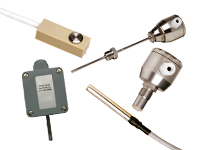 solids. Our range of temperature sensors is as broad as the different applications they can carry out. In addition to resistance sensors (Pt100)
  UK customers +44(0) 23 809 870 30 /
 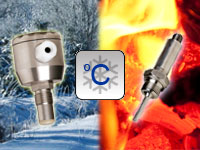 . Temperature sensors transform a physical quantity into a resistance or voltage. Temperature sensors can be used for many different applications as for instance to measured temperature at home, in the office or a material temperature during its boiling process. They are used in both the industrial and the private sectors. Temperature sensors use different physical effects to transform temperature into an electrical quantity. Resistance sensors change their electrical resistance when temperature changes. Since the characteristic curve is not always linear, corrections should be done to get the highest accuracy. The Pt100 is a very common resistance sensor. It is a platinum sensor with a resistance from 100 ohms to 0ºC. Thermo elements also use the so-called Seebeck effect. This effect causes direct voltage in connections. Because of this effect is only in the µV range and it is necessary to know the accurate temperature at the measured point, measurement with thermo elements sometimes can be inaccurate. However, they have advantages such as a quick response time they also allow to measure very high temperatures. Thermo-elements can be made up with different materials. Some thermo-elements are identified with letters. (For example, K, J, etc). Measurement ranges are the main difference.
