
|
|
Density Balances/Balances for Density
Density balances determine the density in liquid and solid materials according to the buoyancy method. Density balances are mainly electronic and very accurate. Density balances are very useful when it is necessary to know the density in plastics, rubber, sintered metals, ceramics, glass as well as other non-metallic materials. The method of density determination is characterized by high accuracy and fast results. Density in liquids is measured by means of the buoyancy test with the glass element. On the other hand, the density in solid materials is determinedby using the weight and volume of a sample. The weighing unit in density balances determines the weight. The volume is obtained in relation to the pressure of the sample when it is put into a liquid, so the density of that liquid must be previously known. If you have any questions about our density balances, our engineers are available to help you to get more information about our balances. Call us:  UK customers +44(0) 23 809 870 30 / US customers (561) 320-9162. Our engineers and technicians will be happy to help you when it goes not only about the density balances, but about the other products in the field of regulation and control, and measuring instruments. UK customers +44(0) 23 809 870 30 / US customers (561) 320-9162. Our engineers and technicians will be happy to help you when it goes not only about the density balances, but about the other products in the field of regulation and control, and measuring instruments.
Technical specifications for our Density Balances/Balances for Density can be found at the following links:
|
|
- PCE-PM...T series Density Balances/Balances for Density
(economical, verifiable, weighing range from 300 g to 15 kg, verification value: 0.1 g ... 5 g, RS-232)
|
 |
|
- PCE-LSM series Density Balances/Balances for Density 
(verified density balances, models with weighing ranges of g, RS-232)
|
 |
|
- PCE-LS series Density Balances/Balances for Density
(verified, internal calibration, graphic display, density ranges 500/3,000 g; RS-232)
|
 |
|
- PCE-ABZ 200C series Density Balances/Balances for Density
(good quality balances for density; 0 ... 200 g / 0.1 mg, RS-232)
|
 |
|
- PCE-AB-C series Density Balances/Balances for Density
(verifiable resolution of 0.1 mg, internal calibration, weighing range up to 200 g)
|
 |
|
- PCE-AB series Density Balances/Balances for Density
(density balances with the weighing range of 100 g; readability: 0,1 mg, PC interface)
|

|
The use and application possibilities of this kind of density balances are practically unlimited.
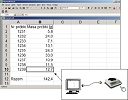
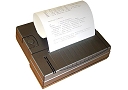
Density balances have a lot of additional accessories such as the software package program (consisting on the software and data cable) to transfer the data to a PC or to a printer.
|
|
|
|
|
Software package
|
Printer
|
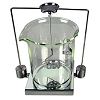
Density meter
|
|
|
An easy process to calculate the density at the laboratory consists of determining the mass and volume of an element and then making the calculation according to the density formula: density [kg/m³] is equal to the mass [kg] divided by the volume. Volume in liquids is measured according to the usual procedure of determining the volume. The use of flasks, cylinders and Pasteur tubes will be necessary to determine the volume in liquids. In the case of the solid materials their volume can be calculated in relation to their shape, as in the case of cubes. With more complex formulae you have the option of putting an object inside a cylinder filled with water. The increase in the level of water will determine the real volume of the object.
Density calculation with hydrostatic balances
According to the Archimedes' Principle an object completely immersed in a fluid (liquid or gas) displaces the volume of fluid exactly equal to the volume of the object. The weight of that volume of the displaced fluid is the buoyant force acting on the object. Besides, the principle states that the buoyant force acting on an object placed in a fluid is equal to the weight of the fluid displaced by the object.
|
|
If you wish to view or print a selection of density balances from our catalogue, click the PDF symbol:

|
