|
CEM: This is the federal authority for legal meteorology in Spain (CEM).
Certificate of revision: Certification from the factory confirming that the product being delivered meets the product specifications (specified on the data sheet).
Connection port: Connection port to a computer for outputting data or updating software (typically an RS-232C)
Conformity certificate: Certification that confirms the device conforms to stringent standards laid out by the notifying body that the device will be compatiable with certain other devices detailed on the certificate.


Declaration of conformity: The document that declares that a device meets CE requirements (electronic devices always come with the distinctive CE certification mark).
DIN EN ISO 9001 certification: this certification signifies that a company has demonstrated that they have adapted their entire management system to meet the DIN EN ISO 9001 standard of quality. After inspection by the relevant authorities, the company is awarded a DIN EN ISO 9001 certificate of quality according to the management system they have in place.
This certificate is completely different from that of the ENAC calibration certificate which relates to the relative characteristics of the technical measurements made by measuring instruments. Certification according to DIN EN ISO 9001 is also not identical to an accreditation, for as yet there is no accords here as to the effects of international recognition.
Data Logger / Data Registers: Many devices have an internal memory for measurement values. This memory can be used in situ to store readings or also programmed to work in conjunction with a computer to store data for further analysis. As such, devices equipped with a data logger can function independently without someone continously monitoring it.

ENAC: The "ENAC" calibration service is a union of technical measurement laboratories that are accredited to be within determined parameters. They are highly competent in the field of technical measurement. An ENAC accredited laboratory has the right to issue internationally established calibration certificates for these parameters and measuring instruments. ENAC certificates are valid in many countries around the world, including those of the European Union.
If you follow the link to ENAC you will be able to find out more about this.

Factory calibration certificate: Factory calibration certificates are issued declaring the standards that are a result of subjecting the measuring instruments to rigorous quality control measures. Quality is assured as the equipment used for quality control are regularly maintained to ensure the highest level of accuracy. The measuring devices are then adjusted using a quality control device and calibrated within the factory.

Ingress protection (IP): The higher the numerical value of IP, the less likely the device is to be disrupted by dust and water penetrating the enclosure.
Interface: Another term to refer to a connection port, see connection port
ISO 9000: System of quality management by way of DIN Standards to identify a companies level of quality control. It's full denomination is DIN EN ISO 9000.

Legibility: The smallest numerical value legible on the device's display.
LCD (Liquid Crystal Display): This display contains liquid crystal which reacts to the anisotropic conductivity of liquid crystals when a current is passed accross it. The displays are not self-lit in Measuring instruments and typically have either a back-light or need to be used in a light room.
LED (Light Emitting Diode) display: This display is formed from a matrix of diodes which emit light in a pattern to display what is expected on screen. The display is self-lighting.

Measurement of deviation: The deviation of the measured value displayed compared to the true value.
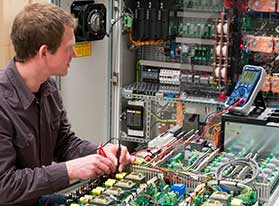
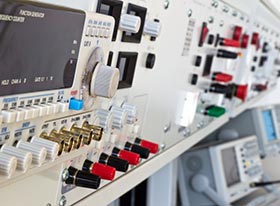
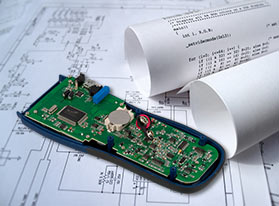
Measuring equipment: These are devices that give visual representation of data and allow for certain parameters to be measured or calculated and displayed in specific unit types. They can be electronic or mechanical devices and can be used in conjunction with a computer and sometimes other devices.
Margin of error: Indicates the maximum range of error possible for any given value displayed by the device.

OIML: "Organization International de Metrologies Legal". Regulates the relative interests in technical measurement in legal contractibility for meteorology. For more infromation follow this link on Meters in the OIML.
Overload /overcharge indicator: Symbol or character displayed by the device to indicate an "overload" which is typically shown as "OL". An overload has the potential to damage the measuring instrument beyond repair.
Operating temperature: The temperature range that the instrument can be used reliably. If the device is used outside of this range, errors can occur in the measurements. If temperatures are extreme the internal electronics of the measuring instruments can be destroyed.

Response time: Period of time from connecting the meter until the measurement result is shown on the display. This refers to the combination of the time of the meter and sensor. As such, a lot of times, it is not related to the meter itself but to that of the sensor that it uses, as typically these are the weakest link.
Recalibration: Periodical devices need to be tested as to confirm their accuracy. If they are inacurate they need to be recalibrated. Visit our webpage to see our Operating partners for calibrating measuring instruments.
Repeatability: This is the process that shows that the measurement shown on the device can be comparable to one or more measurements according to the national standard for the parameter being measured. Thanks to the existing agreement with "CEM" and to the DIN EN 45001 quality standard there is no need to independently demonstrate the devices repeatability.
Resolution: Minimum width of the character represented on the display of measuring instruments, also referred to as a digit.

Standard deviation: A measure used to state the possible variances from the same variable being measured under the same circumstances.

Thermal influence: This is a physical influence on the measurement and can only be corrected via incorporated measurement compensation systems. Some measuring instruments come with automatic temperature compensation available and others have these systems incorporated mechanically, either by an adjustment wheel or by indicating the error occured due to the thermal influence on the display.

Validation: Documented test that a process or procedure meets appropriate safety levels required to perform the specific task.
Below is a video of our company, where you will be able to observe that the development, innovation and technical assessment are our most valued services that we can offer our clients. If you find that none of our devices seem to meet your requirements, please call our offices on:
+44 (0)2380 987030 and our team of engineers will assess your needs and help you choose the device best suited to your requirements.
PCE Instruments have tested its measuring instruments in the Antarctic. With the intention of checking if our equipment has the capacity to resist the extreme temperatures provided by such an environment, and to see if small changes occur in the joints of the thermal insulation that might cause a micro-climate to exist within the boundarys of the device. The teams of engineers conducted astronomical, geological, ornithological and environmental surveys with great success, thanks to equipment provided by PCE for ozone, pH, ultraviolet light, airflow measurements to name but a few.
The Antarctic is a natural laboratory that contains properties that hint to the origins of the Earth and the Solar System. It's clear to see the role the Antarctic ice plays, thanks to the microscopic pockets of air that remain trapped in layers of ice. It is these pockets of air that are extremly important in the estimation of different climatic changes (glaciations) that have occurred upon the Earth's surface over time. These measurements can be used to show how the Earths climate has changed and can even be used in conjunction with future predictions to show how the climate will change in the future, if certain scenarios come to exist and we do not change our ways in terms of usage of fossil fuels.
Contributing factors of climatic change are the greenhouse effect, and the depletion of the ozone layer in the upper atmosphere, permitting UVB radiation to reach the planet's surface. This has been caused, in part, by increased human industrialization in the last decades. As a result, the Earth naturally makes adjustments to effect climate change, these cyclical movements, precession and notation, that are made to the Earth's position in relation to the sun, as well as its own cycles and evolution which are evidenced by changes in the Earth's atmosphere, marine currents, and external forces such as asteroids. The history of the Earth's climate allows scientists to determine which geographical area has been affected by climate changes. It's a mistake to believe that a particular geographical region has always been under the same climatic conditions through its history. What's certain is that an atmospheric change on the planet will result in vast changes for people today and this is the reason why so many people are afraid of climate change.
Final note:
The information presented here may not be complete or exact. It is simply provided as a guide in relation to measuring instruments. The pages within the domain www.industrial-needs.com are property of PCE Instruments UK
Ltd.
|





 UK customers +44(0) 23 809 870 30