|
Discontinuous Regulators
Regulators are divided in different types: discontinuous regulators and continuous regulators. The discontinuous regulators have a simple property of commutation. When a limit value is reached, a relay is activated or deactivated. Because the way of working is in interrupted form, these types of regulators are denominated discontinuous regulators. The discontinuous regulators can be final switches or a bimetal.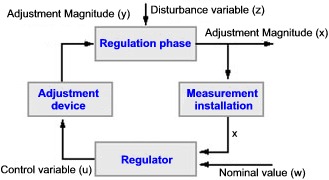 The regulators of this type are the simplest regulators. They are emphasized by its robustness and its excellent relation quality price. Due to their economic price the discontinuous regulator are acquired by companies with a low budget. The discontinuous regulators are different from the regulators of two points and regulators of three points. The regulators of this type are the simplest regulators. They are emphasized by its robustness and its excellent relation quality price. Due to their economic price the discontinuous regulator are acquired by companies with a low budget. The discontinuous regulators are different from the regulators of two points and regulators of three points.
The regulators of two points are characterized by the swtich ON/OFF commutator. They can be regulators of pH in the residual water sector where they require to verify continuously the water tanks. If the regulator detects that the residual waters are too acid, that is to say, the pH value is below 4, in such case the regulator would connect a pump to add an alkaline solution to neutralize the water. The regulator verifies that the residual waters are again in the normal values and it deactivates the pump.
The regulators of three points have a system of switch ON, OFF, ON. This is very advantageous in the sector of the air conditioning. Regulators of temperature measure the environmental temperature. In case the temperature falls below a limit value, for example 19 ºC, the regulator switches on the heating in the offices to assure pleasant working conditions. And when during summer, the temperature is over 24 ºC, the regulator can, by means of a second relay, switch on the air conditioning and lower the blinds, regulating a temperature previously predetermined.
Continuous Regulators
We also have the continuous regulators which 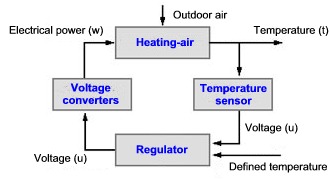 can receive many values almost continuously. The analogue output of the regulators controls the activator or trigger. The trigger is an element of the regulation field that influences the regulated magnitude (i.e. the temperature in a heating). Through the output, these regulators control the consistency with which they will influence the regulated magnitude. If the regulator gives an output with the maximum value, the heating will render to the maximum. On the contrary, if the minimum value occurs like an output, the heating will not even ignite. The possibility “of dosing” the heating capacity allows the continuous regulators a fast and precise adjustment of the magnitude regulated in relation to the set-point. Nevertheless, it is important that the regulators calculate the “dose accurately”. As output for such measurements the regulators measure the available variation of the regulated magnitude of reference value. The reaction to this variation can be, for example, proportional, but as this is technically not optimal an integral or differential part is additionally calculated. The necessary parameters must be detected for the corresponding field of regulation and they must be kept in the regulator internal memory. In addition, modern PID regulators offer other functions that independently detect the optimal parameters. can receive many values almost continuously. The analogue output of the regulators controls the activator or trigger. The trigger is an element of the regulation field that influences the regulated magnitude (i.e. the temperature in a heating). Through the output, these regulators control the consistency with which they will influence the regulated magnitude. If the regulator gives an output with the maximum value, the heating will render to the maximum. On the contrary, if the minimum value occurs like an output, the heating will not even ignite. The possibility “of dosing” the heating capacity allows the continuous regulators a fast and precise adjustment of the magnitude regulated in relation to the set-point. Nevertheless, it is important that the regulators calculate the “dose accurately”. As output for such measurements the regulators measure the available variation of the regulated magnitude of reference value. The reaction to this variation can be, for example, proportional, but as this is technically not optimal an integral or differential part is additionally calculated. The necessary parameters must be detected for the corresponding field of regulation and they must be kept in the regulator internal memory. In addition, modern PID regulators offer other functions that independently detect the optimal parameters.
Continuous Regulators with
commutated output
In order to work with continuous regulators with an analogue output, triggers with their corresponding inputs are necessary. Some regulators make a continuous regulation by means of a command or control contact, while varying the time of activation of a contact in fixed cycle. Therefore, the contact of control of these regulators is closed permanently with the maximum influence of the regulated magnitude. Following the example of the temperature regulation, the heating would be warming up to the maximum. Nevertheless, if you wish only half of this temperature, the contact of control of the regulator will ignite only 50% of the time. This type of regulators can be used only with slow alterations of the regulated magnitudes, because the relays have a frequency of limited commutation.
Timer and function ramp Regulators
Some models of the regulators offer a timer and the ramp function. These functions allow the regulators reach different set-point values in a predetermined sequence. Also, it is possible to fix the speed with which the regulators must change the regulated magnitude. This allows the regulators automate processes without the necessity to manipulate the regulators.
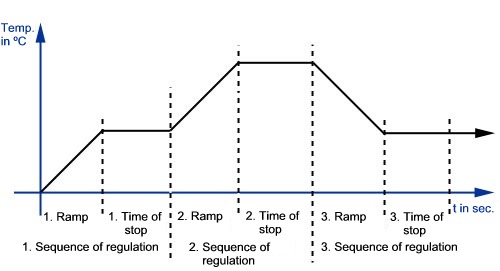
Terms and definitions in the regulation and control system and instruments of regulation used.
Specific or predefined value: standard value or reference value
Regular value: present value or magnitude of control
Regulation output: Magnitude of reference
Control element: Trigger
Regulated body: Field of regulation
Structure of regulation: It indicates how the reference instruments exert an influence on the magnitudes of control. It is defined by the way of action and the type of control systems. Examples of it are: 2 point regulators, 3 point regulators, continuous regulators, cascade regulators or multizone regulators.
Behaviour of the regulation: It is the form in which the regulators tend to influence in the physical magnitudes. These are the most common regulators with switch on/off commutator, PID regulators and adjustable regulators.
|



 UK customers +44(0) 23 809 870 30 /


