|
Penetrometers
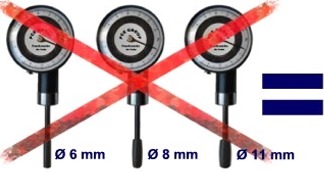
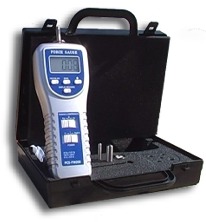
Penetrometers measure the firmness or hardness of fruit. Penetrometers are ideal for determining the best time to harvest fruit or to test its progress to maturity. The firmness of fruit is one of the most widely used parameters in testing its maturity, together with measuring the fruits sugar content using refractometers. Electronic penetrometers come with different diameter penetration points. This allows for fruit of different size and hardness to be tested. It is important that this first part of the measurement process is done correctly if the readings obtained are to be valid in making adequate decisions as to when the fruit should be harvested. It is important the the samples that are measured are representative of the entire crop, considering a sufficient minimum quantity sample, size and quality. If you can't find the penetrometers you are looking for, please contact us and we will help you find the best solution to suit your needs by calling our offices on:  UK customers +44(0) 23 809 870 30 / US customers (561) 320-9162 and our technical staff will advise you regarding our measuring instruments. UK customers +44(0) 23 809 870 30 / US customers (561) 320-9162 and our technical staff will advise you regarding our measuring instruments.
Technical specifications for the PCE-PTR series penetrometers can be found here.
|
|
It's convenient to establish a protocol of your own samples, valid for each year of a crop. An example of samples would be as follows: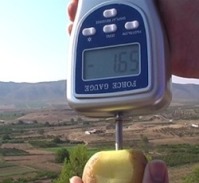 from 10 - 15 days before the usual start time of harvest season each year, a sample of 10 - 15 fruits should be taken every 3 - 4 days to represent the entire crop, taken at random across the entire plot. It's important that the fruit taken should be uniform in size representing the average size as the fruit's hardness will vary with the size of fruit (take into account that the bigger the fruit, the softer it will be). It is also important that the fruit chosen is completely sound, and does n from 10 - 15 days before the usual start time of harvest season each year, a sample of 10 - 15 fruits should be taken every 3 - 4 days to represent the entire crop, taken at random across the entire plot. It's important that the fruit taken should be uniform in size representing the average size as the fruit's hardness will vary with the size of fruit (take into account that the bigger the fruit, the softer it will be). It is also important that the fruit chosen is completely sound, and does n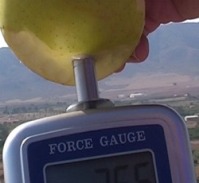 ot have any problems such as damage, rotting or infestations that might alter the normal maturity process that will occur to the rest of the crop. The same type of sample can be effective in testing fruit being transported or in storage. Climacteric fruit is that which is capable of continuing to mature after being harvested, therefore if it must be stored for a long period of time or transported over great distances, it is recommended that the fruit is harvested early and tested with penetrometers to determine if it has reached its physiological maturity on arrival. This maturity is fundamentally due to this type of fruit, when it is not on the plant, increasing its respiration rate and its production of ethylene, the main hormone responsible for the maturing process and fermentation of the fruit. Of course, non-climacteric fruit stops maturing once it is separated from the plant. It is primarily for this reason that ethylene is frequently used as an artificial treatment to change the maturing process of many types of fruits that are conserved in cold storage areas. This link has more information about fruit to allow for accurate measurements with this device. Next, this link, shows some tables and equivalence graphics between hardness indicated by penetrometers in their measurements (g) and the pressure really exerted (Kg./cm2), according to the penetration point used. According to DIN standards, the tables are organised by the function of the recommended ranges for each type of fruit. To take a penetration measurement there are different types of penetration points available to use and a suitable range for each type of fruit. For fruits such as grapes and cherries, the 6mm diameter point is required, to work in a range of 0 - 1kg, for fruits such as plums, lemons and other medium hard fruit, the 6mm diameter point or the 8mm diameter point can be used to work in a range of 0 - 5kg. For apples, pears peaches or kiwis, the 8mm diameter point or the 11.3mm diameter point is needed to work in a range of 0 - 13kg, and for very hard fruit the 11.3mm diameter point, will be required to work in a range of 0 - 20kg. ot have any problems such as damage, rotting or infestations that might alter the normal maturity process that will occur to the rest of the crop. The same type of sample can be effective in testing fruit being transported or in storage. Climacteric fruit is that which is capable of continuing to mature after being harvested, therefore if it must be stored for a long period of time or transported over great distances, it is recommended that the fruit is harvested early and tested with penetrometers to determine if it has reached its physiological maturity on arrival. This maturity is fundamentally due to this type of fruit, when it is not on the plant, increasing its respiration rate and its production of ethylene, the main hormone responsible for the maturing process and fermentation of the fruit. Of course, non-climacteric fruit stops maturing once it is separated from the plant. It is primarily for this reason that ethylene is frequently used as an artificial treatment to change the maturing process of many types of fruits that are conserved in cold storage areas. This link has more information about fruit to allow for accurate measurements with this device. Next, this link, shows some tables and equivalence graphics between hardness indicated by penetrometers in their measurements (g) and the pressure really exerted (Kg./cm2), according to the penetration point used. According to DIN standards, the tables are organised by the function of the recommended ranges for each type of fruit. To take a penetration measurement there are different types of penetration points available to use and a suitable range for each type of fruit. For fruits such as grapes and cherries, the 6mm diameter point is required, to work in a range of 0 - 1kg, for fruits such as plums, lemons and other medium hard fruit, the 6mm diameter point or the 8mm diameter point can be used to work in a range of 0 - 5kg. For apples, pears peaches or kiwis, the 8mm diameter point or the 11.3mm diameter point is needed to work in a range of 0 - 13kg, and for very hard fruit the 11.3mm diameter point, will be required to work in a range of 0 - 20kg.
|