
|
||||
|
Insulation Meters Here you can see insulation meters from these companies:
Below you will find technical specifications for Insulation Meters by clicking on the appropriate link: |
||||
|
- PCE-IT55 Insulation Meters |
|
|||
|
- PCE-UT 512 Insulation Meters
|
  |
|||
|
- PCE-UT
532 Insulation Meters |
 |
|||
|
- Metriso C Insulation
Meters |
  |
|||
|
- Metriso
5000 A Insulation Meters |
 |
|||
|
- ISO-Calibrator 1 Insulation Meters |
 |
|||
|
(Selection of different test currents, it determines the current relative to the time of trigger) |
 |
|||
|
- TG basic 1 Insulation Meters (Insulation Meters with automatic test procedure, battery-operated, easy-to-use, good-bad rating) |
  |
|||
|
Information How to measure using an insulation meter? - disconnect power source - connect the N and PE cables between two points - disconnect the fuse from the device being measured, then connect the LS and FI cables and then reconnect the power - connect the measurement cables between to phase conductor and PE and between the phase conductor and N, then connect the insulation meter and take the measurement. It seems sensible to us to take a measurement between the conductor phase to easily detect damage or aging of the lines. The minimum values of resistance of an insulation meter for measurement of voltage should be 250V DC 0.25 MΩ, at 500V DC 0.5 MΩ and at 1000V DC 1 MΩ. Please take into account that the following points for an insulation meter: 1. Follow the instructions of use exactly as stated. 2. Don't expose insulation meters to extreme temperatures or humidity such as water 3. Avoid extreme moisture. 4. Don't use insulation meters when there is gas, inflammables, vapours or solvents present. 5. Don't use insulation meters near strong strong electrical (motors, transformers, etc) 6. Before turning on an insulation meter, ensure that operating conditions are stable. 7. Repair and maintenance work on insulation meters, as well as opening them, must be carried out only be specially trained technicians of PCE Instruments. 8. Special care should be taken when working with voltages in excess of 25V (AC or DC). Contact with high voltages can cause death. 9. Each time the range of measurement is changed, the insulation meters contact should be removed from the object being measured. 10. Before taking a measurement, the user should check the test points of the insulation meter to ensure they are not damaged or broken. 11. Don't touch the points of measurement as this will effect the readings. 12. Voltage between the device and ground cannot go beyond CAT III 1000V. 13. Don't place insulation meters with their control panels face down on a table or work surface, as this may damage the device. 14. Never make changes or modifications to the insulation meter. |
||||
|
If you wish to view or print a selection of Insulation meters from our catalogue, click the PDF symbol. |
||||
 UK customers +44(0) 23 809 870 30 /

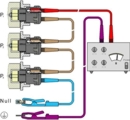 for taking measurements with an insulation meter: When should a measurement be taken?
|
|
|
You are currently at: Home / measuring instruments and test equipment / Insulation Meters |
|
If you have any questions, call our offices on: |
|
This page in German |



 in Hungarian
 in
Bulgaria
in
Bulgaria  in Russian
  in Turkish

 and in Portuguese