|


|
|
|
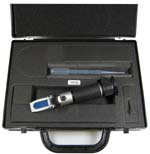
Refractometers Here you will find a variety of refractometers for the measurement of dry substances and different mixtures. We have different refractometers for ranges of 0-10, 0-18 up to 45-82% brix or degrees Oechsle (°Oe) to evaluate wines and liquors, as well as refractometers for the food industry. We also have refractometers that can measure the quantity of coolants, anti-freeze, thickeners, etc. Refractometers are easy to use and have highly accurate optical devices which are based on the principles of light refraction by a prism through a small sample of substance to get a reading, ideal for all types of professionals. Here are conversions for refractometer measuring units. All our refractometers come with ATC except the PCE-SG and include automatic temperature compensation. If you can't find the temperature readers you are looking for, please contact us and we will help you find the best solution to suit your needs by calling our offices on: +44 (0)2380 987030 and our technical staff will advise you regarding our products.
Here you
can see refractometers from these companies:
 
Technical specifications for our refractometers can be found at the following links:
|
|
- PCE-4582 Refractometers (For condensed milk, jam and concentrates: in brix)
|
  |
|
- PCE-2862 Refractometers (For juice concentrates and liquids with sugar: in brix)
|
  |
|
- PCE-032 Refractometers (For translucent juices and emulsions: in brix)
|
  |
|
- PCE-018 Refractometers  (For juices of low concentration and pulp: in brix)
|
  |
|
- PCE-010 Refractometers (for emulsions and low concentrations: in brix)
|
  |
|
- PCE-Oe Refractometers  (For grape growing and wine lovers: in °Oe, brix and babo)
|
  |
|
- PCE-5890 Refractometers (For bee keeping and honey: in % of water, baum, brix)
|
  |
|
- PCE-0100 Refractometers (For measuring salt content: in % / specific gravity, 1.0 to 1.07)
|
  |
|
- PCE-SG Refractometers  (For coolants, anti-freeze, cleaning products)
|
  |
|
- PCE-ALK Refractometers (For accurate testing of alcohol content: in % (0 to 80))
|
  |
|
- ABBE-2WAJ Refractometers (Refractometers to measure accurately the refractive index and the sugar content)
|
  |
|
- AR2008 Refractometers
(Sugar content 0.0 ... 95.0 %, Prism illumination LED 589 nm)
|
  |
|
- RF
5381 Refractometers
(to identify gemstones, integrated 590
nm monochromic filter, variable ocular)
|
  |
|
Included is a test pipette and a screwdriver for making adjustments.
|
|
Next you will find examples of some refractometers. If the parameters that you require are not met in the standard models we have available, read the final paragraph below or consult one of our technicians.
|
|
 Refractometers for beekeeping, for salt content and for coolants.
Some refractometers come with different unit scales. The visible line between the blue area and the white area defines the reading. With Oechsle - Winzer refractometers, you can measure in ºOe, Brix and Babo.
|

Refractometers for beekeeping
|
If you wish to determine, with the help of a refractometer, concentrations in watery solutions that don't appear in the previous list, including those containing colorants, this does not pose a problem. You should only measure a sample once with a refractometer. Using the following example, let's say the result was 12.9% brix. Now we take a dry sample of the same substance in a drying cabinet or a chemical analysis in a laboratory. As an example, the result is 8.2% of the solid matter. Now divide both results and the factor is 1.57. In this way, we obtain the correlation between the refractometer and the laboratory. Now when we measure using only the refractometer we will only need to divide the readings by the value 1.57 and we will then see the value of work. The following link shows a conversion table of degrees Brix to potential alcohol content (% of Vol.) and a summary explanation of the measurement process.
|
|
Many of our refractometers indicate the measurement results in degrees of Brix. Liquid has a level of one Brix (=1% Brix) when it possesses a minimum density of a solution containing 1g sucrose to 99g of water; it has 10 Brix (=10% Brix) when its density is equivalent to a content of 10g sucrose in 90g of water. Sucrose is used as an indicating reference for content of sugar. The measurement for a dry soluable substance in a liquid (and as such we can approximate the content of sugar, is normally indicated in degrees Brix (º Brix). Indirectly we establish the value of the ripeness of fruit. Some CE commercial standards , for kiwi and melon, stipulate that fruit require a sufficient degree of ripeness, which means to say that the standard requires that the fruit have a certan Brix value. The unit of measurement used by refractometers takes its name from Adolf F. Brix, a scientist in the 19th century who, in 1870, developed the means for determining the content of sugar in liquids. The CE commerical standard for kiwis, melons and watermelons clearly establish the measurement value taken by refractometers to determine the ripeness for harvest.
|
|
 |
 |
 |
|
We have refractometers available to take measurements of water and sugar content in honey.
|
We also have refractometers available for measuring alcohol content in clear liquids that contain no pigmentation.
|
We have refractometers for the wine industry that can determine the potential alcohol content of a grape.
|
If you wish to view or print a selection of temperature sensors from our catalogue, click the PDF symbol.

|
|