|
 A-weighting A-weighting
The sensitivity of human hearing depends on the frequency. Low and high tones are perceived with less precision than the tones in between. In the measurement of noise or sound this is taken into account and the frequencies contained within the sound are valued differently with respect to the A-weighting curve.
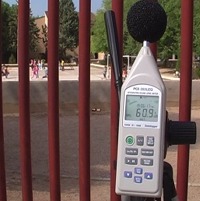
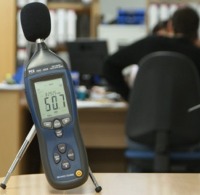
Sound readings are taken in decibels (dB) (A). The A-weighting curve is used primarily in the environmental and industrial sectors; the B and C curves are used for louder sounds and are less frequently used. The noise analysers most commonly used for these measurements are the PCE-999 and the PCE-322A.
 Decibel Decibel
The decibel consists of one tenth of a bel (B). A bel is defined as a logarithm of the bahaviour of two readings of the same type. It is used for the measurement of sound levels although the actual sound output is determined in relation to a specified reference intensity
Abbreviation: dB.
Calculation: LP = 10 * log (P / P0) in dB
where
P = sound output
P0 = specified reference intensity (typically, 10 - 12 Watt)
 Equivalent continuous noise level (Leq) Equivalent continuous noise level (Leq)
The equivalent continuous noise level is an energy mean of the noise level averaged over the measurement period (T) and often regarded as an average level.
Its also part of a sound level over a duration of time (X) that describes a noise with duration D has the same value as a noise that has half the duration (D / 2), but for this it has a sound level of 3dB ( = 10 * log 2) higher (to take this measurement you require the PCE-353 noise analyser.)
The Leq is calculated in this way:
Leq = q/log2 * log(1/T ( 10(log2/q)* Li * ti)
Li = unique event level
T = period of measurement (for example: 16 hours),
ti = duration of the unique event, the maximum level can't be increased by more than 10dB,
q = equivalence parameter or division by two. Provides the change of level, that is equivalent to a constant level to duplicate or divide by two the effective time. Normally at international level q=3, corresponding to the energy equivalence.
Regular measurment of chance occurances with constant intervals (example, 1/10 or 1/100 s) the value can be occur analogically to the number of the chance value
Leq = q/log2 * log(1/N ( 10 (log 2/q)* Li)
where the symbols are exactly the same as in the previous equation.
 Infrasound Infrasound
Frequencies below 16 Hz (Hz = 1/s)
 Level day-evening-night (Lden) Level day-evening-night (Lden)
According to the proposed directives of the EU relating to "Measurement and treatment of environmental noise" for the index of produced noise: day/evening/night level. The evening hours are 19:00 to 23:00 o'clock, with a supplement of 5dB and at night from 23:00 to 7:00 o'clock, with a supplement of 10dB (for example, the noise analyser serie-1900.)
Level day-night (Ldn)
Day-night average sound level is the average noise level over a 24 hour period. With it, different measurements can be taken at different times of the day.
 Maximum level Maximum level
Maximum value is a sound event also denoted as a peak sound. In sound bursts, it's easier to determine various peak points and establish a maximum average or extract the L1 percentile level.
Measurement level
The measured sound level calculated over a period of time in a measurement of noise which has certain noise level specifications be means of noise level corrections. For these measurements it is advised to use noise analysers with the Frequency analysis function.
Abbreviatons: RL (rating level), during daytime (LT); during nightime (LN) (in dB).
In American English it is also referred to as Ldn frequency.
 Peak level Peak level
Maximum sound level reached in a sound burst, also called maximum level. Because of possible loud oscillations, it provides a better description of the average maximum level or the L1 percentile level.
 Solid bodies Solid bodies
Sound that spreads and impacts with solid bodies such as ceilings and walls of buildings. This has high importance in the noise produced by the construction sector.
Sound pressure level
The magnitude of sound pressure of a source (px) relative to a level reference sound pressure (p0). L = 20 log (px/p0). It is expressed in decibels (dB), almost always compared with frequency value, for example, dB (A).
Sound energy
The physical energy of a source of radiated sound.
Sound event level (SEL)
(also LAE). Parameter largely related to the LAeq. With it isolated events can be determined (for example, air transit or passing traffic). The sound energy is normalized to a temporary duration of 1 second.
Sound TA
Technical indication for the protection against noise
General prescription administered by the Federal emissions law 26.8.98. In ruido TA value directives are determined that should be followed precisely to protect the public from the harmful effects of noise. Ruido TA has advanced in force to be used for installations with authorisation and for those that don't require authorisation.
 Temporary value Temporary value
To be able to follow oscillating sound levels in display instruments that were previously constant, different temporary constants are introduced: Fast, Slow, Impulse. Normally the temporary value that you should employ is prescribed.
Sound bursts are considered to have a more imbalanced frequency than sounds events of longer durations. For this reason, it has to be taken into account in the reading, the duration of the bursts by way of a temporary value. (source: UBA).
|



 UK customers +44(0) 23 809 870 30 /