Measuring Instruments/
Test Equipment

PCE Group oHG: Worldwide Supplier of Anemometers Home
Service
Faq's
Business Terms
Contact
 

go to weather stations.


go to weather stations.


go to weather stations.


go to weather stations.


go to weather stations.


Weather stations
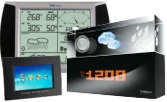
At PCE-Group you will find a wide range of weather stations.Weather stations for professional. These weather stations are used both indoors and outdoors for measuring humidity, temperature, wind speed and air pressure. We offer you different weather stations as handheld and tabletop, environmental meters, measurement converters for industrial applications. Some weather stations can also automatically count dew point or with the ability to store data for analysis on a computer after measurements have been taken. Weather stations are very important in industrial processes, warehouses, and of course in the private sector, such as in a house to determine interior and exterior climate and humidity in walls. For these reasons we recommend using weather stations for testing and making the right decisions. If you don't find the weather stations you are looking for, please contact us and we will help you find the best solution to suit your needs by calling our offices on: +44 ( 0 ) 191 377 3398
and our technical staff will advise you regarding our measuring instruments.

Technical specifications for weather stations can be found at the following links:

- PCE- FWS 20 Weather stations PCE- FWS 20 Weather stations: temperature, humidity, pluviometry, wind speed, logger, USB adapter, Software.
  (temperature, humidity, pluviometry, wind speed, logger, USB adapter, Software)

PCE-FWS 20 Weather stations.

- WatchDog Weather stations
  (cup vane weather stations to measure temperature, humidity, pluviometry, wind speed..)

WatchDog Weather stations: cup vane weather stations to measure temperature, humidity, pluviometry, wind speed..

 Technical specifications for environmental meters can be found at the following links:

- PCE-HT71 Weather stations
  (temperature, humidity, internal sensor and memory for 32,000 values)

Weather stations: temperature, humidity, internal sensor and memory for 32,000 values.

- PCE-222 Weather stations 
  (4 devices in 1, internal light, sound, humidity and temperature sensors)

PCE-222 Weather stations: 4 devices in 1, internal light, sound, humidity and temperature sensors.

- PCE-EM882 Weather stations 
  (4 devices in 1, measures light, sound, humidity and temperature)

PCE-EM882 Weather stations: 4 devices in 1, measures light, sound, humidity and temperature.

- PCE-310 Weather stations  
  (measures temperature, humidity, dew point and includes a surface temperature sensor)

PCE-310 Weather stations: measures temperature, humidity, dew point and includes a surface temperature sensor.

- PCE-320 Weather stations  
  (measures temperature, humidity and dew point)

PCE-320 Weather stations: measures temperature, humidity and dew point.

- PCE-HT110 Weather stations
  (external display, temperature and relative humidity sensor, RS-232, internal memory)

PCE-HT110 Weather stations: external display, temperature and relative humidity sensor, RS-232, internal memory.

- PCE-THB 40 Weather stations
  (Weather stations
with SD card (max. 16 GB), large LCD display / diverse units)

PCE-THB 40 series Weather stations with SD card (max. 16 GB), large LCD display / diverse units.

- PCE-313 Weather stations  PCE-313 Weather stations: with memory, interface and software for data transmission.
  (with memory, interface and software for data transmission)

PCE-313 Weather stations: with memory, interface and software for data transmission.

- Weather stations (humidity)
  (electronically measures climatological conditions in laboratories and warehouses)

Weather stations (humidity): electronically measures climatological conditions in laboratories and warehouses

- PCE-G1 Weather stations 
  (temperature and relative humidity, big display)

PCE-G1 Weather stations: temperature and relative humidity, big display.

- Weather stations Weather stations: Anemometers measures air velocity and volume of air current.
  (measures air velocity and volume of air current)

Weather stations: measures air velocity and volume of air current.

- Barometers
  (handheld barometers for measuring absolute pressure)

Weather stations: handheld barometers for measuring absolute pressure.

- Temperature meters 
  (contact and non-contact devices)

Weather stations: contact and non-contact devices.

All weather stations are calibrated and can also have an optional calibration to be certified to meet DIN EN ISO standards.All weather stations are calibrated and can also have an optional calibration to be certified to meet DIN EN ISO standards. The ISO calibration for weather stations consists of a laboratory calibration according to a measurement protocol and an ISO certification. For companies that wish to integrate weather stations into their internal quality control system of for doing annual recalibrations. The ISO certificate includes a laboratory calibration and a document containing weather stations measurement values as well as the name and the details of the company or the client that orders the device. Weather stations sensors are long term stable so an annual or regular calibration will not be required. Some special adjustments in our weather stations can be performed for the industrial sector (change of sensors, sintered filters, to stretch diverse connections, etc..). If you wish to make a special measure or if you have problems with your weather stations, please do not hesitate to get in contact with us and our technicians and engineers will be available to help you in order to find the best solution.

 :: The Weather :: Spain

Weather stations are formed by different meters to measure meteorological elements and they are used for weather observation. Weather stations are mainly used to measure and forecast State weather conditions however they can be also used for private measurements. There are differences between digital and analogue weather stations. Analogue weather stations are placed in "meteorological shelters" (also known as Stevenson's thermometer shelters  which are small weather-resistant wooden or plastic boxes to protect measuring instrument not only against rain and dirty but also they provide accurate measuring values. Meteorological shelters allow air to flow inside them and they are usually white painted to protect temperature values against direct sun light. If the boxes were painted with dark colors, they would absorb more radiation transferring it inside the shelter so this would increase internal temperature in relation to the  external one so the meteorological shelter would always register high temperature values. To compare weather station values they have to be placed 2 meters on the floor and 10 meters from the nearest tree and exposed to wind and sun during all the day. Weather stations normally come with a psychrometer, a thermometer with max. and min. values and a hygrothermogram . Besides, outside the meteorological shelter a pluviometer and an anemometer are placed. Modern weather stations can also measure  global solar radiation, sunlight duration and some special values such as the floor evaporating temperature. Analogue weather stations do not need to be powered via the mains and allow to get accurate results. The disadvantage is that meteorological values can be only registered manually every time

PCE-FWS20 weather stations in its location for use.                    PCE-FWS20 weather stations connected to a PC for transference of files.

The state of the art in the Weather stations sector offers a real time weather forecast system . Weather stations results with this forecast system are calculated by a group of meteorologist who work for "Wetter-Online". Some times a day a free automatic satellite sign with weather conditions for 90 regions in Europe is sent. So you will have always current and detailed weather details. The advantage is that these forecasts are regional and very accurate.

What is the relationship between weather and atmospheric pressure in weather stations?

Different atmospheric pressure conditions (different symbols or they can be introduced through the keypad) appear when air mass rises with different force in different places of Earth. This occurs due to the fact that the Sun heats up air mass in Ecuador heavier than in both Poles. Solar heating decreases gradually form Ecuador to the Poles. Air mass from Ecuador descends in those areas which are far from  Ecuador where air is not as warm as in other places. The air of these areas is displaced by the air which comes from Ecuador that descends when it is cold. In those regions it doesn't rain a lot due to the fact that descended air mass are heated by pressure so clouds cannot be created and  cloudiness is dispersed. There are three great air mass systems from Ecuador to the Poles. These air mass systems are continuously ascending and descending. Both, anticyclones and disturbances are created by earth's rotation. A disturbance means that air is ascending so clouds are formed due to the fact that air contains gas moisture that becomes water drops when temperature descends (weather stations show clods formation and rain). An anticyclone means that air at ground level is displaced in all directions by high pressure (also weather stations show the wind). In those regions where there is an anticyclone air mass descends at ground level. When it descends, air is heated and this air can absorb more humidity and clouds are dissolved. As a result, we will have a clear sky and sun. Many weather stations uses atmospheric pressure to determine weather forecast.

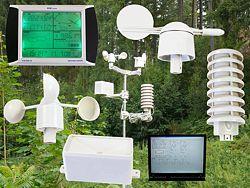
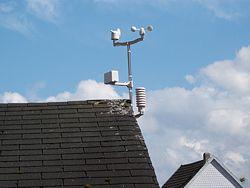
Weather stations with all their accessories.           Weather stations vertical mast.

Weather stations are not only used for global purposes but also for local ones. Although weather stations show current meteorological details in a very easy way, they can be also used for a long-term observation, the analysis of the registered values as well as for reactions when they are under or above certain values. Weather stations can be connected to a software of analysis and to a port. Weather stations have a wide range of applications such as private or industrial ones. Apart from measuring internal temperature and environmental humidity, other sensors can be used to determine wind direction, wind speed, etc... . Weather stations transmitters have a reach of 100 m (without any obstacle). All the sensors are automatically detected by weather stations, so they can be used instantaneously. Weather stations show through their great displays current meteorological values and weather evolution (for example: barometric tendency). Meteorological data can be registered by means of the analysis software . All meteorological details can be transferred to a PC or a computer. Weather stations are used to observe and analyze meteorological data as well as to react when meteorological changes occur.

What are weather stations?

Weather stations are places where meteorological measurements and observations of the different meteorological parameters using suitable instruments to establish an atmospheric behavior.

Below, you will find a classification of the general characteristic of weather stations according to technical standards:

  • Pluviometric stations: Weather stations with a pluviometre or other recipient which allows to measure the amount of rain between two consecutive measurements.

  • Pluviographic stations: when weather stations can make automatically and continuously a rainfall registration. The amount of water, intensity, duration and period of rain can be known.

  • Main weather stations: to make observations of atmospheric conditions in order to provide information to make weather forecasts and to study the weather and climate. The measurements taken include temperature, barometric pressure, humidity, wind speed, wind direction, and precipitation amounts. Wind measurements are taken as free of other obstructions as possible, while temperature and humidity measurements are kept free from direct solar radiation, or isolation.  They are normally taken three different observations per day.

  • Ordinary weather stations: They must be provided with a psycometer, pluviometer and a pluviograph to measure rainfalls and temperature instantaneously.  

  • Main synoptic stations: These stations are used for important meteorological elements observations during international connectivity hours. Meteorological information is taken every hour: cloudiness, wind speed and wind direction, atmospheric pressure, air temperature, clouds high and types, visibility, special phenomena, humidity, rainfalls, cloud layers, wind course, atmospheric phenomena sequence. The information is encoded and interchanged through the different World Meteorological Centers for weather forecast and also for the aviation service.

  • Additional synoptic stations: Observations are also done during international connectivity hours. Meteorological information is related to: visibility, special phenomena, atmospheric weather, cloudiness, state of ground, rainfalls, air temperature and humidity, wind, etc...g

  • Agrometeorological stations: They are used for both meteorological and biological observations and any other observation which help to determine relations between weather and climate as well as  between the life of animals and the life of plants.  They have the same observations programs than main weather stations..

WatchDog weather stations are an affordable solution for producers, consultants, researchers as well as any other job related to meteorology. Growing conditions can be monitored, registered and analyzed for a efficient production control as well as pest control. WatchDog weather stations offer an accurate a real time information about weather conditions from your field or vineyard. Modern and advanced characteristics lately included in WatchDog weather stations are also offered:

  • To improve data management due to the fact that it enables diverse people to download database from these meteorological stations. Storage capacity is tripled and it grows measuring time.

  • Also, displays of weather stations have been improved, so it is possible to check until 30 days of data as well as max. and min. values. Also, displays show calculations of hours / cold and days/ grade.

  • Diverse functions have been improved: communication, transference speed to 9600 bauds, individualized transference with other weather stations, etc.  

  • WatchDog weather stations are very easy to handle. Adjustment of the sensor and measuring range are operated by means of the weather station keyboard (adjustment through the computer is not necessary).

Information about relative humidity: Relative humidity (r.h.) shows the relationship between absolute humidity (the amount really there) and the saturation state of water vapors. Relative air humidity is measured using humidity indicators, that show on their displays from 0% (absolutely dry air) up to 100% (air that is completely saturated, such as fog, clouds or steam bath). Some models of humidity indicators are an unlimited measurement range. The physical area is between 40 and 65% r.h. Given that hot air possesses the ability to absorb more water vapour than cold air, people feel that in winter, air is too dry and in summer it is too humid. If air heats up it increases the amount of water vapour to that of saturation. The consequence is that the % of relative humidity decreases while the real quantity of water remains constant. Something similar occurs when air is cooled, decreasing the quantity of water vapour. This increases the percentage value of relative humidity. Condensation forms when there is an excess of water in saturated conditions. Some of our humidity indicators offer the ability to not only measure relative humidity and temperature, but can also calculate dew point and dew point temperature. Dew point temperature is defined as the temperature at which the actual vapour content of air is the maximum (100% relative humidity). Dew point temperature is independent of the actual temperature. One possibility of dew point temperature is freezing metal until its surface forms condensation. The temperature of the metal will then be the dew point temperature. As we have mentioned, many of our weather stations show dew point on their display.

If you wish to print a selection of weather stations from our printed catalogue, click the PDF symbol

If you wish to print a selection of weather stations from our printed catalogue, click the PDF symbol.

You are currently at: Home / measuring instruments and test equipment / Weather stations

If you have any doubt, call our technicians on: +44 ( 0 ) 191 377 3398.

This page in German Weather stations in German in Italian Weather stations in Italian. in Spanish Weather stations in Spanish in Croatian Weather stations in Croatian in French Weather stations in French


Below you will find an overview of the different product groups of measuring instruments

Absolute Humidity Meters
Accelerometers
Alert Meters
Air velocity meters
Analyzers (Colour)
Analyzers (Gas)
Analyzers (Lan)
Analyzers (Noise)
Analyzers (Oxygen)
Analyzers (Ozono)

Anemometers
Barometers
Balances
Borescopes
Cable detectors (electrical)
Calibrators
Calipers
Cameras (Infrared Thermal Imaging)
Capacitance Meters
Coating Thickness Meters
Chlorine Meters
Clamp Meters
Climate Meters
Colour Meters

Conductivity Meters
Contact Thermometers
Current detectors

Data Loggers
Differential Pressure Meters
Digital Multimeters
Densimeters
Detectors (Humidity, Radiation, Voltage)
Dose Meters (Noise)

Earth meters
Electric Tester
Endoscopes
Fiberscopes
Flow Meters Air
Flow Meters Gas
Force Gauges (digital)
Frequency Meters
Gas Detector
Geiger Counter
Handheld Tachometers
Hardness Meters
Humidity Testers (Building material)
Hygrometers
Indicator Sound Level
Indicator (Humidity)
Instruments (Environmental)

Impedance bridges
Infrared Thermometers
Insulation Meters
Lan Network Testers
Laser Distance Meters
Laser level
Laser meters
Laser thermometers
LCR Meters
Length Meters
Light Meters
Lux Meters
Magnetometers
Manometers
Material Thickness Meters
Measurement Devices (Force)
Measuring Meters (Distance)
Measuring Wheels
Meters (Distance,
Environmental, Gas, Gloss, Ground pH, Power Pressure, Radiation, Salt, Temperature)
Micrometers
Microscopes
Modular signal Converters
Moisture Indicator

Multimeters
Multi-Parameter Photometers
Noise Meters
Odometers
Ohm Meters
Oscilloscopes
Oxygen Meters
Ozone Meters
 Noise Meters
 Odometers
 Ohm Meters
 Oscilloscopes
 Oxygen Meters
Paper Moisture Meters
Penetrometers

Pitot tube air flow meters
Pocket pH-meters
Power Analyzers
Pressure Gauges
Pyrometers
Quality Meters (Air)
Radiation Counters
Radioactivity meters
Reader (Temperature)
Recorders Data
Redox Meters
Refractometers
Relative Humidity Meters
Resistance Testers
Rotation meters
Roughness tester
Rotation meters
Roughness tester
Scales
Sensor (Temperature)
Signal Level Analyzers
Single-parameter Photometers
Sound Level Meters
Systems for Environmental
Stethoscopes (electronic)
Stroboscopes
Surface Thickness Meters

Tachometers
Telescope Meters
Thermo-anemometers
Thermo-Hygrometers
Temperature Probes
Testers Air
Testers Conductivity
Testers Earth
Testers Insulation
Testers Noise
Testers pH
Testers paper
Testers Sound
Testers Temperature
Thermal stress
Thermal Imaging Cameras
Thermometers
Thermocouples
Thickness Meters
Turdibity Meters

Ultrasonic Flow Meters

VDE tester
Vibration Meters
Video endoscopes
Voltage meters
Weather Stations
Wood (humidity)