|
Torque meters are available in two different versions: handheld meters or tabletop meters. Torque meters have a wide
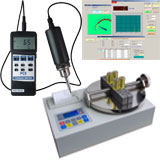 range of applications. Handheld torque meters are mainly used for industry while tabletop
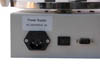
torque meters are the ideal tool for laboratories. Our Torque meters come with a RS-232 port to transfer torque values to a PC or a portable computer.
This is very helpful if you want to save the data and stand the chance to
compare what you have measured afterwards. Another possibility is that you aim
to do long-term-measurements. There the interface and the software are two very
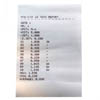
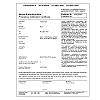
useful features that are given to you. Tabletop torque meters can be equipped with a printer (option). You can also order a ISO calibration certificate as an option.
This ensures that the device has been calibrated and works perfectly including a
measurement with only small deviances that can still be tolerated and do not
influence the product's functions. We can offer you torque meters that can measure
up to a maximum measuring value of 500 Nm. If you can't find the torque meter you are looking for, we can help you to find the measuring instrument that best suits your needs. Call us on: range of applications. Handheld torque meters are mainly used for industry while tabletop
torque meters are the ideal tool for laboratories. Our Torque meters come with a RS-232 port to transfer torque values to a PC or a portable computer.
This is very helpful if you want to save the data and stand the chance to
compare what you have measured afterwards. Another possibility is that you aim
to do long-term-measurements. There the interface and the software are two very
useful features that are given to you. Tabletop torque meters can be equipped with a printer (option). You can also order a ISO calibration certificate as an option.
This ensures that the device has been calibrated and works perfectly including a
measurement with only small deviances that can still be tolerated and do not
influence the product's functions. We can offer you torque meters that can measure
up to a maximum measuring value of 500 Nm. If you can't find the torque meter you are looking for, we can help you to find the measuring instrument that best suits your needs. Call us on:  UK customers +44(0) 23 809 870 30 / US customers (561) 320-9162 and our engineers and technicians will
assist you with all the measuring instruments,
scales
and balances and products that come from the field of regulation
and control that are available at PCE
Instruments. UK customers +44(0) 23 809 870 30 / US customers (561) 320-9162 and our engineers and technicians will
assist you with all the measuring instruments,
scales
and balances and products that come from the field of regulation
and control that are available at PCE
Instruments.
Here you can see torque meters
from these companies.
     
Technical specifications about torque meters can be found at the following links:
|
|
- PCE-TM 80 Torque Meters 
(Torque meters with external probe, up to a max. of 147 Ncm, peak value, RS-232, software)
|
 |
|
- Torque
Meters HTG2
(Hand-held torque meter with separate sensor for measuring the torque of
screws)
|
 |
|
- Torque
Meters MVD-series
(Torque meters with a big measuring range for exact measurements)
|
 |
|
- Torque
Meters 516.33 series
(to test torque keys, variable tool holding fixture, measuring
range 1 ... 240 mNm)
|

|
|
- Torque
Meters DTX2
(Desktop-torque meter for checking the opening and close torque of
bottles, glas jars, cosmetics etc.)
|
 |
|
- Torque
Meters 516.34 series
(variable tool holding fixture, precision of measurement: ±6 %
tolerance, measuring range 1 ... 150 cNm)
|

|
|
- Torque
Meters PCE-TTM series
(torque tester for screw caps, up to 10,000 Nm, internal
memory, incl. software, peak hold function)
|

|
|
- Torque
Meters TI 112
(Torque meters with a measuring range from 20 Ncm to 1000 Ncm)
|
 |
|
- Torque
Meters 516.12 Serie
(to adjust torque keys, measuring range 3 ...
800 mNm or 3 ... 800 cNm)
|

|
|
- Torque
Meters 516.0100
(with automatic shutoff, precision of measurement: ±1 % tolerance,
measuring range 5 - 500 Nm)
|

|
|
- Torque
Meters MTG
(Automatic desktop-torque meter with memory and output signal for
checking the opening and close torque)
|
 |
|
- Torque
Meters PCE-FB-TW series
(for values up to 500 Nm, external torque transducer 1/4' female square
)
|
 |
|
- Torque
Meters PCE-MMT E
(for various sensors with TEDS, internal flash drive, opt. software, 1
... 5000 Nm, 50 ... 2000 Hz sampling rate)
|
 |
|
- Torque
Meters PCE-SA / PCE-SB series
(torque gauge bar for permanent installation, 1 ... 5000 Nm, to measure
static reactive torque, TEDS module)
|
 |
|
- Torque Meters in force meters
(Torque meters: At this link you can find tensile and compressive force meters)
|
 |
| The force of a
rotating object (it is normally referred to as engines) is shown by means of the “moment of force” or torque moment. Example: If we put a load of 10 kg on a vertical beam 10 m out from a pivot, the torque moment produced on the axis will be 100 Nm (or 10,000 Ncm). A 100 Ncm geared meter could elevate a lever from 1cm up to 10 kg (in one axis). |
|
RS-232 port of the torque meter
|
Tabletop torque meters come with a printer
|
ISO calibration certificate for torque meters
|
|
|
Torque
meters are essential for many parts in the professional field wherever torque
needs to be measured. As it has been mentioned before, we offer different types
of torque meters. Especially hose ones that are handheld are very comfortable to
use since you can operate these non-stationary devices on machines etc. that are
not movable but where you need to measure the torque anyways. In this case you
can simply take the torque meters where you need them. It is possible that you
get the torque meters with an internal or with an external cell that measures
torque - both are possible and both are within our product range. We can offer
you torque meters wit a wide measurement range up to 500 Nm. To ensure exact
measurements and highest usability our products possess highest accuracy and a
high reading precision. The torque meters have as little buttons as possible in
order to guarantee user highest enjoyments when measuring with these
devices.
Detailed description: the physical dimension of the “torque moment” is the result of both the
for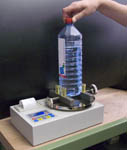 ce and the displacement. The unitary system SI has the measuring unit of the “torque moment” the Newton Nm: 1 Newton meter = 1 kgm²/s². ce and the displacement. The unitary system SI has the measuring unit of the “torque moment” the Newton Nm: 1 Newton meter = 1 kgm²/s².
Definition: If there is a force exerted to the gravity
center of a rigid body which is freely in motion, this body will speed itself, that means that the speed will be modified. This body will perform a rectilinear translation movement (displacement). However, if the body is fixed at a static point, there will not be any translation and the displacement will only be a
rotating movement in relation to the static point. The magnitude which influences this
rotating movement, that is the cause of the modification of the rotating speed is called “torque”. All our torque meters can be calibrated to meet the DIN ISO standard. This can be ordered within the instrument or it can be recalibrated (annually or according to the internal quality control). We will send the instrument with the certificate.
|
|
If you wish to view or print a selection of our torque peters, click on the PDF symbol.

|