Measuring Instruments/
Test Equipment

PCE Group oHG: Worldwide Supplier of Anemometers Home
Service
Faq's
Business Terms
Contact
 

go to endoscopes.


go to endoscopes

Endoscopes

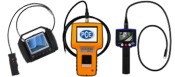
Endoscopes are the ideal tool for inspection and maintenance. Endoscopes offer new perspectives of theEndoscopes are the ideal tool for inspection and maintenance. insides of machines. Thanks to its flexible fibre optic cables and its light weight enclosure, these extraordinaries endoscopes can locate problems and conflicts very easily and quickly, allowing for preventative measures to be taken without the need to dismantle the machinery first. Endoscopes are used mainly by electricians, security personnel, specialists in the professional sector, and mechanics of all types.  Endoscopes are exceptional tools in places such as schools or universities, especially in practical applications. Don't hesitate to call us if you wish to enquire about our endoscopes. If you don't find the endoscopes you are looking for, please contact us and we will help you find the best solution to suit your needs by calling our offices on: +44 ( 0 ) 191 377 3398 and our technical staff will advise you regarding our measuring instruments.

Technical specifications for our Endoscopes can be found at the following links:

- PCE-DE 25 series Endoscopes  PCE-E 130 series Endoscopes: endoscopes with 1220mm flexible length and a diameter of 6mm
  (LCD endoscopes / LED Lighting / 880 mm length / Ř 10 mm)

PCE-E 130 series Endoscopes: endoscopes with 1220mm flexible length and a diameter of 6mm

- PCE-DE 100 series Endoscopes
  (endoscopes with total length of 930mm, Ř 10.5mm, connects to a computer)

PCE-DE 100 series Endoscopes: total length of 930mm and a diameter of 10.5mm, connects to a computer.

- PCE-VE 320 / PCE-330 / PCE-340 series Endoscopes PCE-VE 320 / PCE-330 / PCE-340 series Endoscopes: 2m long cable and a diameter of 5mm, 2GB internal memory, software.
  (endoscopes with 2m long cable, Ř 5mm, 2GB internal memory, software)

PCE-VE 320 / PCE-330 / PCE-340 series endoscopes: 2m long cable and a diameter of 5mm, 2GB internal memory, software.

- PCE-VE 350 series Endoscopes
  (800 mm
long cable, Ř 6,0 mm / 360ş addressable, 512 MB memory)

PCE-VE 350 series endoscopes with 800 mm long cable, diameter 6,0 mm / 360ş addressable, 512 MB memory

- PCE-VE 310 series Endoscopes
  (endoscopes with 920 mm long cable, Ř5,8 mm, micro SD memory)

PCE-VE 310 series Endoscopes: 920 mm long cable and a diameter of 5,8 mm, micro SD memory.

- PCE-VE 400 / 500 series Endoscopes
  (wireless video endoscopes, LED illumination, memory, Ř 5,5 mm)

PCE-VE 400 / 500 series Endoscopes: wireless video endoscopes, LED illumination, memory, diameter of 5,5 mm.

- PCE-V220/V250 series Endoscopes
  (Endoscopes / video Endoscopes, color monitor 5,6", length 20 m)

PCE-V220 series Endoscopes: Endoscopes / video Endoscopes, color monitor 5,6", length 20 m.

- PCE-V240/V260 series Endoscopes
  (Endoscopes / video Endoscopes, color monitor)

PCE-V240 series Endoscopes: Endoscopes / video Endoscopes, color monitor.

Endoscopes are very easy to use and can be handled by technicians with limited experience.

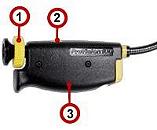
functionality of endoscopes 

1   ring for focal adjustment

2  Light switch (press it to illuminate the visual area)

3   Handle (enclosure)

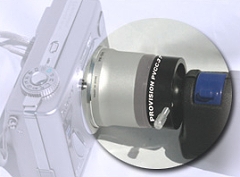
Endoscopes function without the possibility of saving images.  Of course, we offer an adaptor which will allow you to connect the endoscope to a digital camera, permitting you to capture images, digitize them and document them in a PC. The adaptor has a diameter of 37mm. It is a standard adaptor for most types of digital cameras, although some models will require another adaptor to accomodate from 52mm or 48mm to 37mm. Unfortunately we only have the 37mm adaptor available from our store, the other adaptors can be found at shops specializing in photography and its components, for example, Hama.


digital camera adaptor for endoscopes
 

endoscopes: camera adaptors
We sell adaptors for all types of endoscopes that we have available
 

          endoscopes: View of a system board          endoscopes: View of a dollar bill          endoscopes: Image taken by a camera attached to a endoscope          endoscopes: view in a digital camera display          endoscopes: adapted to a camera    endoscopes and tripod
If you follow the following image links you can see a larger image of all the adaptors shown. You can also see a short video that shows endoscopes being used on an American racing car: video
Click here if you wish to see images of a endoscope in use.

Take into account that the adaptors are only suited to the standard lens size previously mentioned, and it isn't possible to put in it's place just any type of digital camera. As such, you will have the capacity to document the areas inspected by the endoscope. The digital camera is not included with the endoscope when you order. Consult use about any doubts you may have regarding the adaptors for endoscopes or regarding the apparatus itself.


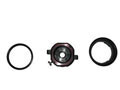
Almost all of the endoscopes come with a 45° mirror attachment to increase the field of vision. You can also order a magnet attachment to locate magnetic objects, such as a screw, and extract them.

                           endoscopes: replacement halogen bulb                         endoscopes: magnet to locate and extract objects                        45° mirror for endoscopes                        the endoscope comes with a carrying case

General  Endoscopes for cavities with limited accessibility informationEndoscopes for cavities with limited accessibility. about endoscopes: Endoscopes have a cylindrical form that contains a light and a lens that magnifies the image from the optic fibres to allow a visualization of the area being analysed to determine the fault. Endoscopes are traditionally used for diagnostics in the sector of medicine.  Today, they are used in the industrial sector, for cavities with limited accessibility (injection moulds, machinery, motors, casting, etc..). Our endoscopes are are flexible and return to their original form after they are extracted. For documentation we offer these endoscopes with camera and video adaptors. The two images above show two examples of the endoscope at work. To the right you can see that an automobile's exhaust pipe is being inspected for oxidation, obstructions and fractures. To the left it is being used to inspect the plumbing of a sink for obstructions.
Attention: Our endoscopes are not to be used in the field of medicine.  They can only be used in the industrial sector, DIY, product development along with personal use such as for hobbies.

What is optical fibre?

Optical fibre is a flexible optically transparent fibre, usually made of glass or plastic, through which light can be transmitted by successive internal reflections. Beams of light go through optical fibre from one end to the other (including curves and corners) without any interruption.

Optical fibres can now be used as conventional copper wires, both in small autonomous environments (such as data processing systems of planes), as large geographic networks (such as long lines of urban systems maintained by telephone companies).

With the development of extremely low-loss optical fibres during the 1970s, optical fibre communication became a very important form of telecommunication almost instantaneously. For fibres to become useful as light waveguides (or light guides) for communications applications, transparency and control of signal distortion had to be improved dramatically and a method had to be found to connect separate lengths of fibre together. Reducing distortion over long distances required modification of the method of guidance employed in early fibres. These early fibres (called step-index fibres) consisted of two coaxial cylinders (called core and cladding) which were made of two slightly different glasses so that the core glass had a slightly higher index of refraction than the cladding glass. By reducing the core size and the index difference in a step-index fibre, it is possible to reach a point at which only axial propagation is possible. In this condition, only one mode of propagation exists. The fibres used in long-distance telecommunications applications are always glass, because of the lower optical attenuation. Today the fibre optic is used for fast communication purpose in world so therefore nowadays number of multinational companies have changed their communication infrastructure to fibre optics. Lasers generate “coherent “intense Light while diodes emit “incoherent” light which is not as concentrated as laser light is.

Most optical fibres are made of sand or silica, abundant raw material compared to copper. With a few kilos of glass approximately 43 kilometres of optical fibre can be produced.

The two essential parts of optical fibres are the core and coating. Core is the inner part of the optical fibre and it is used to guide Light. It consists of one or more class or plastic thin strands with a diameter from 50 to 125 microns. The coating is the part that surrounds and protects the core. Both the core and the coating are surrounding by a plastic or other materials cover to protect them against moisture, crushing, rodents, and other environmental hazards.


There are three main alignment types: road, rail lines or high voltage lines.

Main advantages of the optical fibre:

• It has a wide bandwidth (up to 1THz). This is possible thanks wavelength division multiplexing (WDM/DWDM). This technique allows for sending up to 100 light beams (with different wavelengths) at a speed of 10Gb/s.  

• Totally immune to electromagnetic interferences.

• Smaller size than previous media.

• Abundant raw material.

Main disadvantages of the optical fibre:

• High fibre fragility.

• More expensive transmitters and receivers.

• Difficult joining fibres. It is more difficult to make simple repairs in case of cable breakage.

• Electricity cannot be transmitted to power intermediate repeaters.

• In many cases it is necessary to perform electric-optical processes.

Influence of moisture content on the optical fibre cables.

Moisture is one of the most important enemies of the optical fibre.

The optical fibre consists essentially of crystal quartz (silicon dioxide, SiO2). Its chemical reaction in presence of H + OH radicals (SiO2 + OH = SiO3 H) results, in combination with Na or Ca present in water to sodium or calcium silicates, which are soluble.

A fibre corrosion process begins. This can become in cracks and in the attenuation increasing and even in the total breakdown of communications or in the fibre breakage.

This video shows the use of the endoscopes for maintenance works. These extraordinary endoscopes can locate problems and conflicts very easily and quickly, allowing for preventative measures to be taken without the need to dismantle the machinery first saving time and money. They are used for visual inspections of a particular point in equipments and industrial machinery. You can see that in some ports the embedded switch does not operate properly due to the fact that technicians did not connect the cables to power the device or they are cut. These endoscopes with display are suitable to perform easily and with quality remote visual inspections to take any preventive measurement without dismantling the machinery. Most of the endoscopes can be used together with many accessories to make visual inspections easier by using  cameras, lights, application and focusing lens, etc.  

In this picture we can see the switch we has inspected in the video with the endoscope.

In this picture we can see the switch we has inspected in the video with the endoscope.

Thanks to the PCE-VE 320 endoscope it has been possible to take these photographs. These endoscopes allow to record both fixed images and videos about the inspection processes to be used for further  analysis. The recording process is easily performed owing to video endoscopes have a large display to view the inspection in real time  during this process.

The PCE-VE 320 endoscope showing the inspection of the switch on the display.

The PCE-VE 320 endoscope showing the inspection of the switch on the display.

If you wish to view or print a selection of endoscopes from our catalogue, click the PDF symbol.
Go to endoscopes


You are currently at: Home / measuring instruments and test equipment / endoscopes

If you have any doubt, call our technicians on: +44 ( 0 ) 191 377 3398.

This page in German Endoscopes in alemán german. in Italian Endoscopes in italian. in Spanish Endoscopes in Spanish. in Croatian Endoscopes in croatian. in French Endoscopes in French.


Below you will find an overview of the different product groups of measuring instruments

Absolute Humidity Meters
Accelerometers
Alert Meters
Air velocity meters
Analyzers (Colour)
Analyzers (Gas)
Analyzers (Lan)
Analyzers (Noise)
Analyzers (Oxygen)
Analyzers (Ozono)

Anemometers
Barometers
Balances
Borescopes
Cable detectors (electrical)
Calibrators
Calipers
Cameras (Infrared Thermal Imaging)
Capacitance Meters
Coating Thickness Meters
Chlorine Meters
Clamp Meters
Climate Meters
Colour Meters

Conductivity Meters
Contact Thermometers
Current detectors

Data Loggers
Differential Pressure Meters
Digital Multimeters
Densimeters
Detectors (Humidity, Radiation, Voltage)
Dose Meters (Noise)

Earth meters
Electric Tester
Endoscopes
Fiberscopes
Flow Meters Air
Flow Meters Gas
Force Gauges (digital)
Frequency Meters
Gas Detector
Geiger Counter
Handheld Tachometers
Hardness Meters
Humidity Testers (Building material)
Hygrometers
Indicator Sound Level
Indicator (Humidity)
Instruments (Environmental)

Impedance bridges
Infrared Thermometers
Insulation Meters
Lan Network Testers
Laser Distance Meters
Laser level
Laser meters
Laser thermometers
LCR Meters
Length Meters
Light Meters
Lux Meters
Magnetometers
Manometers
Material Thickness Meters
Measurement Devices (Force)
Measuring Meters (Distance)
Measuring Wheels
Meters (Distance,
Environmental, Gas, Gloss, Ground pH, Power Pressure, Radiation, Salt, Temperature)
Micrometers
Microscopes
Modular signal Converters
Moisture Indicator

Multimeters
Multi-Parameter Photometers
Noise Meters
Odometers
Ohm Meters
Oscilloscopes
Oxygen Meters
Ozone Meters
 Noise Meters
 Odometers
 Ohm Meters
 Oscilloscopes
 Oxygen Meters
Paper Moisture Meters
Penetrometers

Pitot tube air flow meters
Pocket pH-meters
Power Analyzers
Pressure Gauges
Pyrometers
Quality Meters (Air)
Radiation Counters
Radioactivity meters
Reader (Temperature)
Recorders Data
Redox Meters
Refractometers
Relative Humidity Meters
Resistance Testers
Rotation meters
Roughness tester
Rotation meters
Roughness tester
Scales
Sensor (Temperature)
Signal Level Analyzers
Single-parameter Photometers
Sound Level Meters
Systems for Environmental
Stethoscopes (electronic)
Stroboscopes
Surface Thickness Meters

Tachometers
Telescope Meters
Thermo-anemometers
Thermo-Hygrometers
Temperature Probes
Testers Air
Testers Conductivity
Testers Earth
Testers Insulation
Testers Noise
Testers pH
Testers paper
Testers Sound
Testers Temperature
Thermal stress
Thermal Imaging Cameras
Thermometers
Thermocouples
Thickness Meters
Turdibity Meters

Ultrasonic Flow Meters

VDE tester
Vibration Meters
Video endoscopes
Voltage meters
Weather Stations
Wood (humidity)