Measuring Instruments/
Test Equipment

PCE Group oHG: Worldwide Supplier of Anemometers Home
Service
Faq's
Business Terms
Contact
 

go to Noise meters.


go to Noise meters.


Noise meters
Here  you will find noise meters that meet industrial standards. These portable noise meters allows for rapid control of a situation to be taken but also for test measurements over entire shifts, and there are different noisenoise meters has importance in all industries, especially by way of a mobile device which is able to assess office stress levels or street noise levels. meters for distinct frequencies. These noise meters to measure general noise or background noise are gaining importance across all areas, in particular on the spot measurements in offices and in the street. Measuring noise is an integral part of measuring environmental conditions, most particularly in the private sector. Noise meters are often noise problems between neighbors or when a restaurant or bar is produces lots of noise after 22:00 at a time when regulations stipulate that noise levels be reduced. Some of these class I and II noise meters can take measurements that can be presented in court as evidence. There are also accessories available, such as a microphone extension cord (except for the PCE-999), tripods, calibrators and DIN ISO calibration certificates for all our models. If you require more information, you can view our page outlining typical illumination standards or if you don't find the noise meters you are looking for, please contact us and we will help you find the best solution to suit your needs by calling our offices on: +44 ( 0 ) 191 377 3398
and our technical staff will advise you regarding our products.

Technical specifications for our noise meters can be found at the following links:

  - PCE-222 series noise meters
    (noise meters with internal sensors for sound, light, temperature and relative humidity)
PCE-222 series noise meters: includes internal sensors for sound, light, temperature and relative humidity.

- PCE-EM882 series noise meters
  (noise meters to measure sound, light, temperature and humidity sensors)

PCE-EM882 series noise meters: includes sound, light, temperature and humidity sensors.

- PCE-999 series noise meters  PCE-999 series noise meters: Standard industrial device, accurate to ±1.5dB, calibrated.
  (Standard industrial noise meters, accurate to ±1.5dB, calibrated)

PCE-999 series noise meters: Standard industrial device, accurate to ±1.5dB, calibrated

- PCE-318 series noise meters
  (noise meters from 26dB, accurate to ±1.5dB, analogue output)

PCE-318 series noise meters: measures from 26dB, accurate to ±1.5dB, analogue output.

- PCE-322 A series noise meters  PCE-322 A series noise meters: similar to the PCE-999 but with internal memory
  (noise meters similar to the PCE-999 but with internal memory)

PCE-322 A series noise meters: similar to the PCE-999 but with internal memory.

- PCE-353 series noise meters 
  (similar to the PCE-322A, with Leq function) 

PCE-353 series noise meters: similar to the PCE-322A, with Leq function.

- PCE-DSA 50 series noise meters 
  (
class 1 noise meters with 1:1 and 1:3 octave filters, measures in real time

PCE-DSA 50 series noise meters: class 1 device with 1:1 and 1:3 octave filters, measures in real time.

- PCE-355 series noise meters 
  (noise meters for the detection of sound bursts at the workplace)

PCE-355 series noise meters: for the detection of sound bursts at the workplace.

All noise meters can come accompanied with a microphone extension, a sound calibrator and an ISO calibration certificate. Noise meter come calibrated from the manufacturer. Over time, the sensors lose accuracy and this is why they need to be recalibrated on a regular basis. You can do your own calibration using the sound calibrator device or you can return the meter to us to have it calibrated in our laboratory and you will receive a test certificate.

Noise meters: Sound calibrator (class I and II)

Noise meters: Microphone extension cable (allows measurements to be taken at a greater distance)

Noise meters: Mains adaptor (to conserve battery power when transfering data) 

Noise meters: Tripod (to ensure optimum placement of the meter)

Sound calibrator (class I and II)
(for regularly recalibrating noise meters

Microphone extension cable (allows measurements to be taken at a greater distance)

  Mains adaptor (to conserve battery power when transfering data)   

Tripod (to ensure optimum placement of the meter)

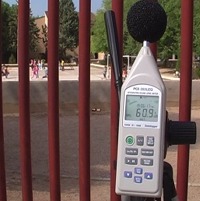
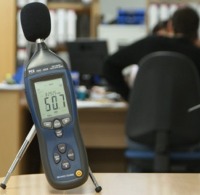
Below are some images of different noise meters being used in situ. The image to the left shows a device measuring noise levels in an office. The image in the centre shows a device using a data logger in a cutting machine and the image to the right shows a noise meter on top of a tripod to allow for measurements to be taken over an extended period of time on a motorway.

Noise meters: a device measuring noise levels in an office

Noise meters: a device using a data logger in a cutting machine

Noise meters: a noise meter on top of a tripod to allow for measurements to be taken over an extended period of time on a motorway


Here we can see how our PCE-353 sound meters with tripod take measurements during a period of time.

If you would like more information about using noise meters or measuring sound in general, click the links below
(PCE Group is not responsible for the authenticity and accuracy of the information contained within the links)

Measuring sound / noise

Operation / Use

Noise in the workplace

Noise meters: A A-weighting
The sensitivity of human hearing depends on the frequency. Low and high tones are perceived with less precision than the tones in between. In the measurement of noise or sound this is taken into account and the frequencies contained within the sound are valued differently with respect to the A-weighting curve.
Sound readings are taken in decibels (dB) (A). The A-weighting curve is used primarily in the environmental and industrial sectors; the B and C curves are used for louder sounds and are less frequently used. The noise meters most commonly used for these measurements are the PCE-999 and the PCE-322A.

Noise meters: B Measurement level
The measured sound level calculated over a period of time in a measurement of noise which has certain noise level specifications be means of noise level corrections.  For these measurements it is advised to use noise meters with the Frequency analysis function.
Abbreviatons: RL (rating level), during daytime (LT); during nightime (LN) (in dB).
In American English  it is also referred to as Ldn frequency.

Noise meters: D Decibel
The decibel consists of one tenth of a bel (B). A bel is defined as a logarithm of the bahaviour of two readings of the same type. It is used for the measurement of sound levels although the actual sound output is determined in relation to a specified reference intensity
Abbreviation: dB.
Calculation: LP = 10 * log (P / P0) in dB
where
P = sound output
P0 = specified reference intensity (typically, 10 - 12 Watt)

Noise meters: E Equivalent continuous noise level (Leq)
The equivalent continuous noise level is an energy mean of the noise level averaged over the measurement period (T) and often regarded as an average level.
Its also part of a sound level over a duration of time (X) that describes a noise with duration D has the same value as a noise that has half the duration (D / 2), but for this it has a sound level of 3dB ( = 10 * log 2) higher (to take this measurement you require the PCE-353 noise analyser.)
The Leq is calculated in this way:

Leq = q/log2 * log(1/T ( 10(log2/q)* Li * ti)

Li = unique event level
T = period of measurement (for example: 16 hours),
ti = duration of the unique event, the maximum level can't be increased by more than 10dB,
q = equivalence parameter or division by two. Provides the change of level, that is equivalent to a constant level to duplicate or divide by two the effective time. Normally at international level  q=3, corresponding to the energy equivalence.

Regular measurment of chance occurances with constant intervals (example, 1/10 or 1/100 s) the value can be occur analogically to the number of the chance value
Leq = q/log2 * log(1/N ( 10 (log 2/q)* Li)
where
Li = value of chance occurance
N = total number of chance occurances over a period of measurment.
The sound level of extended duration with equivalent energy used for acoustic description  of different sources of environmental noise (noise from planes, trains, etc.) In Germany the Leq is normally know as the level median (Lm).

Noise meters: I Infrasound
Frequencies below 16 Hz (Hz = 1/s)

Noise meters: K Solid bodies
Sound that spreads and impacts with solid bodies such as ceilings and walls of buildings. This has high importance in the noise produced by the construction sector.

Noise meters: L Level day-evening-night (Lden)
According to the proposed directives of the EU relating to "Measurement and treatment of environmental noise" for the index of produced noise: day/evening/night level. The evening hours are 19:00 to 23:00 o'clock, with a supplement of 5dB and at night from 23:00 to 7:00 o'clock, with a supplement of 10dB (for example, the noise analyser serie-1900.)

Ldn
Day-night average sound level is the average noise level over a 24 hour period. With it, different measurements can be taken at different times of the day.

Noise meters: M Maximum level
Maximum value is a sound event also denoted as a peak sound. In sound bursts, it's easier todetermine various peak pints and establish a maximum average or extract the L1 percentile level.

Noise meters: N Noise pollution
Some years ago noise has become a constant polluting agent. Nowadays, noise pollution is a great problem which produces physiological, psychological, economic and social effects. The main cause of noise pollution is human activity. Noise has existed since ancient times, but in the last century with the development of the Industrial Revolution, the creation of new means of transport and the growth of cities, the real problem with noise pollution started.

Noise is defined as an unpleasant and irritating sound. Noise pollution is displeasing human, animal or machine-created sound that disrupts the activity or balance of human or animal life. Noise pollution is specially suffered by people who work in industries and those who use transportation systems frequently.

The source of most outdoor noise worldwide is transportation systems, including motor vehicle noise, aircraft noise and rail noise. Poor urban planning may give rise to noise pollution, since industrial and residential buildings can result in noise pollution in the residential area. Other sources of indoor and outdoor noise pollution are car alarms, emergency service sirens, office equipment, factory machinery, construction works, grounds keeping equipment, barking dogs, appliances, power tools, lighting hum, audio entertainment systems, loudspeakers, and noisy people.

Industrial noise is primarily caused by the performance of different machines in industrial places and in general for all their internal activity. The progressive nuisance produced by the industrial noise is directly related to several factors such as the level of industrialization increasing worldwide, the gradual concentration of industrial activity in confined spaces and the increase of machines’ strength.

Industrial noise is usually considered mainly from the point of view of environmental health and safety, rather than nuisance, as sustained exposure can cause permanent hearing damage. The presence of ultrasound, infrasound and vibration is also of great importance in industrial environments.

Public works or construction works have a great importance as the cause of the nuisance. Compressors, pneumatic hammers, excavators and heavy vehicles of all types produce noise levels so high that, regardless of the significance of prosperity and development that could symbolize, are the target of many complaints from residents of our cities.

Despite efforts to solve this problem, the success achieved so far is not very important. Strategies differ considerably between countries, partly due to the different sensitivity to the same problem, and partly because of the impact of technology and the social and economic behavior in the fight against noise.

Noise meters: S Sound pressure level
The magnitude of sound pressure of a source (px) relative to a level reference sound pressure (p0). L = 20 log (px/p0). It is expressed in decibels (dB), almost always compared with frequency value, for example, dB (A).


Sound energy
The physical energy of a source of radiated sound.


Sound event level
(SEL)
(also LAE). Parameter largely related to the LAeq. With it isolated events can be determined (for example, air transit or passing traffic). The sound energy is normalized to a temporary duration of 1 second.

Noise meters: SPeak level
Maximum sound level reached in a sound burst, also called maximum level. Because of possible loud oscillations, it provides a better description of the average maximum level or the L1 percentile level.

Noise meters: T Ruido TA
Technical indication for the protection against noise
General prescription administered by the Federal emissions law 26.8.98. In ruido TA value directives are determined that should be followed precisely to protect the public from the harmful effects of noise. Ruido TA has advanced in force to be used for installations with authorization and for those that don't require authorization.

Noise meters: Z Temporary value
To be able to follow oscillating sound levels in display instruments that were previously constant, different temporary constants are introduced: Fast, Slow, Impulse. Normally the temporary value that you should employ is prescribed.
Sound bursts are considered to have a more imbalanced frequency than sounds events of longer durations. For this reason, it has to be taken into account in the reading, the duration of the bursts by way of a temporary value. (source: UBA).

If you wish to view or print a selection of noise meters from our catalogue, click the PDF symbol
go to noise meters in the catalogue

You are currently at: Home / measuring instruments and test equipmentnoise meters

If you have any doubt, call our technicians on: +44 ( 0 ) 191 377 3398.

This page in German noise meters in German in Italian noise meters in Italian in Spanish noise meters in Spanish in Croatian noise meters in Croatian in French noise meters in French


Below you will find an overview of the different product groups of measuring instruments

Absolute Humidity Meters
Accelerometers
Alert Meters
Air velocity meters
Analyzers (Colour)
Analyzers (Gas)
Analyzers (Lan)
Analyzers (Noise)
Analyzers (Oxygen)
Analyzers (Ozono)

Anemometers
Barometers
Balances
Borescopes
Cable detectors (electrical)
Calibrators
Calipers
Cameras (Infrared Thermal Imaging)
Capacitance Meters
Coating Thickness Meters
Chlorine Meters
Clamp Meters
Climate Meters
Colour Meters

Conductivity Meters
Contact Thermometers
Current detectors

Data Loggers
Differential Pressure Meters
Digital Multimeters
Densimeters
Detectors (Humidity, Radiation, Voltage)
Dose Meters (Noise)

Earth meters
Electric Tester
Endoscopes
Fiberscopes
Flow Meters Air
Flow Meters Gas
Force Gauges (digital)
Frequency Meters
Gas Detector
Geiger Counter
Handheld Tachometers
Hardness Meters
Humidity Testers (Building material)
Hygrometers
Indicator Sound Level
Indicator (Humidity)
Instruments (Environmental)

Impedance bridges
Infrared Thermometers
Insulation Meters
Lan Network Testers
Laser Distance Meters
Laser level
Laser meters
Laser thermometers
LCR Meters
Length Meters
Light Meters
Lux Meters
Magnetometers
Manometers
Material Thickness Meters
Measurement Devices (Force)
Measuring Meters (Distance)
Measuring Wheels
Meters (Distance,
Environmental, Gas, Gloss, Ground pH, Power Pressure, Radiation, Salt, Temperature)
Micrometers
Microscopes
Modular signal Converters
Moisture Indicator

Multimeters
Multi-Parameter Photometers
Noise Meters
Odometers
Ohm Meters
Oscilloscopes
Oxygen Meters
Ozone Meters
 Noise Meters
 Odometers
 Ohm Meters
 Oscilloscopes
 Oxygen Meters
Paper Moisture Meters
Penetrometers

Pitot tube air flow meters
Pocket pH-meters
Power Analyzers
Pressure Gauges
Pyrometers
Quality Meters (Air)
Radiation Counters
Radioactivity meters
Reader (Temperature)
Recorders Data
Redox Meters
Refractometers
Relative Humidity Meters
Resistance Testers
Rotation meters
Roughness tester
Rotation meters
Roughness tester
Scales
Sensor (Temperature)
Signal Level Analyzers
Single-parameter Photometers
Sound Level Meters
Systems for Environmental
Stethoscopes (electronic)
Stroboscopes
Surface Thickness Meters

Tachometers
Telescope Meters
Thermo-anemometers
Thermo-Hygrometers
Temperature Probes
Testers Air
Testers Conductivity
Testers Earth
Testers Insulation
Testers Noise
Testers pH
Testers paper
Testers Sound
Testers Temperature
Thermal stress
Thermal Imaging Cameras
Thermometers
Thermocouples
Thickness Meters
Turdibity Meters

Ultrasonic Flow Meters

VDE tester
Vibration Meters
Video endoscopes
Voltage meters
Weather Stations
Wood (humidity)