Measuring Instruments/
Test Equipment

PCE Group oHG: Worldwide Supplier of Anemometers Home
Service
Faq's
Business Terms
Contact
 

go to Pyrometers.


go to Pyrometers.


go to Pyrometers.


go to Pyrometers.


go to Pyrometers.


go to Pyrometers.


go to Pyrometers.


Pyrometers
Pyrometers are ideal for taking accurate measurements of temperature without contact. ThanksPyrometers are ideal for taking accurate measurements of temperature without contact. to an optical mechanism, these pyrometers are safe for measuring high temperatures. Their infrared capabilities make them the perfect tool to use when conventional sensor are inadequate. This is in cases when the object is moving, is extremely hot, in a difficult place to access or due to contamination or other negative influences. A large variety of handheld pyrometers are listed in the links below. We are available to answer your queries about pyrometers and the best one to suit your needs. They can be calibrated to meet ISO standards, except the PCE-880 and PCE-888 pyrometers. If you don't find the pyrometers you are looking for, please contact us and we will help you find the best solution to suit your needs by calling our German offices:
+49 (0)29 03 976 99-52; our Italian offices: +39 0583 975 114; or our Spanish offices: +34 967 543 548 and our technical staff will advise you regarding our products.
 

Technical specifications for our pyrometers can be found at the following links:

   - PCE-880 series pyrometers PCE-880 series pyrometers: non-contact device for the workplace or training and education.
     (non-contact device for the workplace or training and education)
PCE-880 pyrometers

- PCE-IR 100 series pyrometers PCE-IR 100 series pyrometers: for measuring surface temperature and interior space.
 
(for measuring surface temperature and interior space) 
 

 PCE-IR 100 pyrometers

- PCE-888 series pyrometers 
  (with infrared and accurate to ±1.5%)

PCE-888 pyrometers

- PCE-889 series pyrometers PCE-889 series pyrometers: graphic display, adjustable emissivity, <1000°C.
  (graphic display, adjustable emissivity, <1000°C)

PCE-889 pyrometers
  - PCE-JR 911 series pyrometers
    (non-contact device with memory and RS-232 interface)
PCE-JR 911 pyrometers
  - PCE-890 series pyrometers PCE-890 series pyrometers: infrared device for measuring temperature up to 1600ºC.
    (infrared device for measuring temperature up to 1600ºC)
PCE-890 pyrometers

- PCE-IR 1800 series pyrometers
  (infrared device for measuring temperature up to 1800°C (metals and ceramics))

PCE-IR 1800 pyrometers

- PCE-IR10 series pyrometers
 
(digital infrared device with LCD for time duration measurements of surfaces)

PCE-IR10 pyrometers

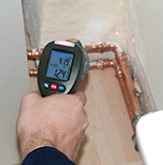
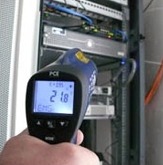
Pyrometers with adjustable K value (emissivity) can be used for measuring the temperature of different materials. Here you will find a table with K values for a diverse range of materials (the table can also be seen lower down this page). All pyrometers are shipped calibrated. An optional ISO calibration certificate (laboratory calibration and certificate) can be acquired for all devices, except for the PCE-880 and PCE-888 pyrometers. Below are some images of pyrometers being used. Contact us if you have any questions: our German offices: +49 (0)29 03 976 99-52; our Italian offices: +39 0583 975 114; or our Spanish offices: +34 967 543 548.

Pyrometers: used in the food industry

Pyrometers: in the automotive sector

Pyrometers: measuring a fuse box

Pyrometers for measuring
frozen goods

Measuring a car motor

Pyrometers for testing fuse boxes

Here you can see some images of pyrometers in use: areas of use for pyrometers. The relationship between the diameter of the measurement point and the distance of measurement (ratio) is alwasys shown on the pyrometer in this way, 8:1, 12:1 or 35:1. The diameter of the measurement point increases when the distance from the pyrometer to the object being measured increases. This means that the measurement point can increase at long distances up to a diameter of 25cm. The graphic that can be seen below also shows this relationship. These pyrometers have, at a short distance, a much more moderate measurement point diameter, for example, at a distance of 30cm the measurement point would be 6mm. Such pyrometers are used for measuring temperature of small areas at short distances.

Example of a surface being measured with a ratio of distance to size of measurement point of 50 : 1

Emissivity depends on the wave length of what is being measured. Please read the user's manual carefully to know the wave length measured by the device you are using.
Note: The values shown below depend on the actual state of the material and the measurement conditions.

Metallic materials   (table with K values)
Material Emissivity
  1.0 µm 1.6 µm 8 - 14 µm
Aluminium
      unoxidised 0.1 - 0,2 0.02 - 0.2 n/a
      oxidised 0.4 0.4 0.2 - 0.4
      A3003 alloy,
      oxidised n/a 0.4 0.3
      rough 0.2 - 0.8 0.2 - 0.6 0.1 - 0.3
      polished 0.1 - 0.2 0.02 - 0.1 n/a
Lead
      polished 0.35 0.05 - 0.2 n/a
      rough 0.65 0.6 0.4
      oxidised n/a 0.3 - 0.7 0.2 - 0.6
Chrome 0.4 0.4 n/a
Iron
      oxidised 0.4 - 0.8 0.5 - 0.9 0.5 - 0.9
      unoxidised 0.35 0.1 - 0.3 n/a
      rusty n/a 0.6 - 0.9 0.5 - 0.7
      molten 0.35 0.4 - 0.6 n/a
Iron, cast
      oxidised 0.7 - 0.9 0.7 - 0.9 0.6 - 0.95
      unoxidised 0.35 0.3 0.2
      molten 0.35 0.3 - 0.4 0.2 - 0.3
Iron, forged
      uncut 0.9 0.9 0.9
Gold 0.3 0.01 - 0.1 n/a
Haynes
      alloy 0.5 - 0.9 0.6 - 0.9 0.3 - 0.8
Inconel
      oxidised 0.4 - 0.9 0.6 - 0.9 0.7 - 0.95
      sand blasted 0.3 - 0.4 0.3 - 0.6 0.3 - 0.6
      electrically polished 0.2 - 0.5 0.25 0.15
Copper
      polished n/a 0.03 n/a
      alloy n/a 0.05 - 0.2 n/a
      oxidised 0.2 - 0.8 0.2 - 0.9 0.4 - 0.8
Magnesium 0.3 - 0.8 0.05 - 0.3 n/a
Bronze
      polished 0.8 - 0.95 0.01 - 0.05 n/a
      highly polished n/a n/a 0.3
      oxidised 0.6 0.6 0.5
Molybdenum
      oxidised 0.5 - 0.9 0.4 - 0.9 0.2 - 0.6
      unoxidised 0.25 - 0.35 0.1 - 0.35
Nickel
      oxidised 0.8 - 0.9 0.4 - 0.7 0.2 - 0.5
      electrolytic 0.2 - 0.04 0.1 - 0.3 n/a
Platinum
      black n/a 0.95 0.9
Mercury n/a 0.05 - 0.15 n/a
Silver n/a 0.02 n/a
Steel
      cold-rolled 0.8 - 0.9 0.8 - 0.9 0.7 - 0.9
      rough n/a n/a 0.4 - 0.6
      polished 0.35 0.25 0.1
      molten 0.35 0.25 - 0.4 n/a
      oxidised 0.8 - 0.9 0.8 - 0.9 0.7 - 0.9
      stainless 0.35 0.2 - 0.9 0.1 - 0.8
Titanium
      polished 0.5 - 0.75 0.3 - 0.5 n/a
      oxidised n/a 0.6 - 0.8 0.5 - 0.6
Tungsten n/a 0.1 - 0.6 n/a
      polished 0.35 - 0.4 0.1 - 0.3 n/a
Zinc
      oxidised 0.6 0.15 0.1
      polished 0.5 0.05 n/a
Tin (unoxidised) 0.25 0.1 - 0.3 n/a

                      n/a = not available
 

Non-metallic materials

Material Emission
  1.0 µm 5.0 µm 7.9 µm 8 - 14 µm
Asbestos 0.9 0.9 0.95 0.95
Asphalt n/a 0.9 0.95 0.95
Basalt n/a 0.7 0.7 0.7
Concrete 0.65 0.9 0.95 0.95
Ice n/a —— 0.98 0.98
Earth n/a 0.9 - 0.98 0.9 - 0.98  
Paint (non alkaline) —— 0.9 - 0.95 0.9 - 0.95  
Gypsum n/a 0.4 - 0.97 0.8 - 0.95 0.8 - 0.95
Glass
      plate n/a 0.98 0.85 0.85
      cast n/a 0.9 n/a n/a
Rubber n/a 0.9 0.95 0.95
Wood (natural) n/a 0.9 - 0.95 0.9 - 0.95 0.9 - 0.95
Calcium carbonate n/a 0.4 - 0.98 0.98 0.98
Carborundum n/a 0.9 0.9 0.9
Ceramic 0.4 0.85 - 0.95 0.95 0.95
Gravel n/a 0.95 0.95 0.95
Carbon
      non corroding 0.8 - 0.95 0.8 - 0.9 0.8 - 0.9 0.8 - 0.9
      graphite 0.8 - 0.9 0.7 - 0.9 0.7 - 0.8 0.7 - 0.8
Paper (coloured) n/a 0.95 0.95 0.95
Plastic
      non translucent n/a 0.95 0.95 0.95
Fabric n/a 0.95 0.95 0.95
Sand n/a 0.9 0.9 0.9
Snow n/a —— 0.9 0.9
Clay n/a 0.85 - 0.95 0.95 0.95
Water n/a —— 0.93 0.93
 
n/a = not available

General information about the principal function of pyrometers: Infrared radiation is an element of solar light that can be seen when light is defracted through a prism. This radiation contains energy. At the beginning of the 20th century, a group of scientists consisting of Planck, Stefan, Boltzmann, Wien and Kirchhoff defined the activity of the elecromagnetic spectrum and they established equations describing infrared energy.
This allows the energy to be defined for pyrometers taking into account the emissivity curves for dark objects. Objects with a temperature higher than absolute zero radiate energy. The amount of energy increases  in proportion to the fourth magnitude.
This concept is the foundation for pyrometers. With emissivity there is also a variable that takes into account average temperature, and this can vary. The emissivity factor is a measurement for the relationship of radiation that a grey object and a black object emit at the same temperature. Pyrometers are produced in many configrations that differ in optics, electronics, technology, size and shape. All pyrometers have one thing in common: Todos los pirómetros tienen algo en común: the channel for signal processing. It starts with an IR signal, and ends with an electronic output signal.

If you wish to view or print a selection of pyrometers from our catalogue, click the PDF symbol

Pyrometers: go to catalogue


You are currently at: Home / measuring instruments and test equipment / pyrometers

If you have any doubt, call our technicians on: +49 (0)29 03 976 99-52 Germany. +39 0583 975 114 Italy. +34 967 543 548 Spain.

This page in German Pyrometers in German in Italian Pyrometers in Italian in Spanish Pyrometers in Spanish in Croatian Pyrometers in Croatian in French Pyrometers in French


Below you will find an overview of the different product groups of measuring instruments

 Absolute Humidity Meters
 Accelerometers
 
Alert Meters
 Air velocity meters
 Analyzers (Colour)
 Analyzers (Gas)
 Analyzers (Lan)
 Analyzers (Noise)
 Analyzers (Oxygen)
 Analyzers (Ozono)

 Anemometers

 Barometers
 Borescopes

 Cable detectors (electrical)
 Cameras (Infrared Thermal Ima.)
 Capacitance Meters
 Coating Thickness Meters
 Chlorine Meters
 Clamp Meters
 Climate Meters
 Colour Meters

 Conductivity Meters
 Contact Thermometers
 Current detectors

 Data Loggers
 Differential Pressure Meters
 Digital Multimeters
 Densimeters
 Detectors (Humidity)
 Detectors (Radiation)

 
Detectors (Voltage)
 
Dose Meters (Noise)

  Earth meters
 Endoscopes
 Environmental Meters
 Fiberscopes
 Flow Meters Air
 Flow Meters Gas
 Force Gauges (digital)
 Frequency Meters
 Gas detectors
 Geiger Counter
 Handheld Tachometers
 Hardness Meters
 
Humidity Testers (Building mat.)
 Hygrometers

Indicators Sound Level
Indicators (Humidity)
Instruments (Environmental)

Impedance bridges
Infrared Thermometers
Isolation Meters

Lan Network Testers
Laser Distance Meters
Laser level
Laser meters
Laser thermometers
LCR Meters
Length Meters
Light Meters
Lux Meters

 Magnetometers

Manometers
Material Thickness Meters
Measurement Devices (Force)
Measuring Meters (Distance)
Measuring Wheels
Meters (Distance, Power,
Pressure, Radiation, Temperature, Gas, Gloss)
Micrometers
Modular signal Converters
Moisture Indicator
Multimeters
Multi-Parameter Photometers

Noise Meters

 Odometers
 Ohm Meters
 Oscilloscopes
 Oxygen Meters
 Ozono Meters

Paper Moisture Meters
Penetrometers
pH-Meters
Pitot tube air flow meters

Pocket pH-meters
Power Analyzers
Pressure Gauges,

Pyrometers

 Quality Meters (Air)
 Radiation Counters
 Radioactivity meters
 Reader (Temperature)

Recoders Data
Redox Meters
Refractometers
Relative Humidity Meters
Roughness tester

Salt Meters
Sensor (Temperature)
Signal Level Analyzers
Single-parameter Photometers
Sound Level Meters
Systems for Environmental
Stethoscopes (electronic)
Stroboscopes
Surface Thickness Meters

Tachometers
Telescope Meters
Thermo-anemometers
Thermo-Hygrometers
Temperature Probes
Testers (Conductivity, Earth,
Electric, Insulation  Noise,
pH  
Resistance, Sound, Temp.)
Thermal stress
Thermal Imaging Cameras
Thermometers
Thermocouples
Thickness Meters
Turdibity Meters

Ultrasonic Flow Meters

VDE tester
Vibration Meters
Video endoscopes
Voltage meters